
The Kalahari’s covert hunters: Why big ecological answers can be found in small carnivores

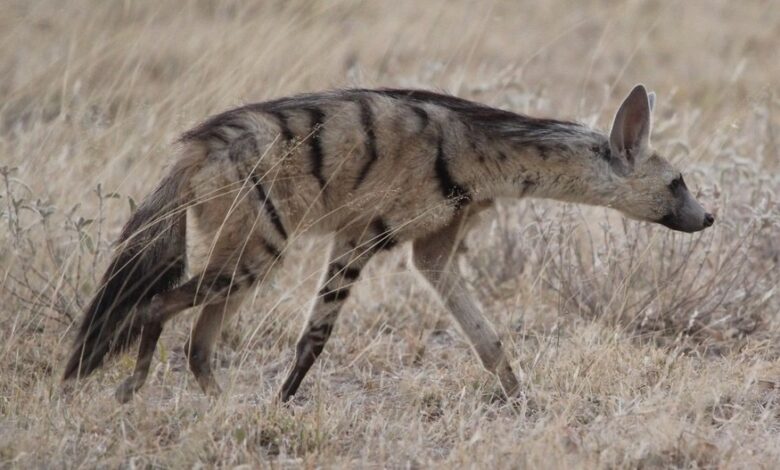
Despite being the undercard of research, brown hyenas, cape foxes, and other middleweights of the carnivore world are important drivers of ecological health. This is about to change thanks to a historic long-term study at Tswalu Kalahari Reserve.
Look down, past the lions and elephants, to comprehend the African savanna. In fact, termites have a higher total biomass than elephants in a typical savanna. The aardwolf is a highly specialized predator of termites, which are enormous ecosystem drivers. However, the insect-eating aardwolf is rarely seen in reserves where lions are the dominant predators.
Zoologist Ara Monadjem states, “I haven’t missed a visit to Kruger National Park in fifty years.” However, I have never witnessed an aardwolf in Kruger. And everywhere else, I’ve seen dozens of them.
Monadjem believes that the lack of suitable open grasslands and the abundance of lions may be contributing factors to the aardwolf’s scarcity in the Kruger.
Monadjem, the head of the zoology and entomology department at the University of Pretoria, and Prof. Michael Somers, the head of the wildlife management and conservation program at the University of Pretoria’s Mammal Research Institute, have been awarded a new long-term Oppenheimer Generations grant to study a number of medium-sized, nocturnal carnivores found in the Tswalu Kalahari Reserve. The brown hyena, aardwolf, bat-eared fox, and Cape fox are the main subjects.
At about 118,000 hectares, the reserve is located in the Northern Cape at the base of the Korannaberg Mountains and is currently the largest privately protected area in South Africa. Kuruman is the closest town.
Ecological rehabilitation—removing internal fences, reintroducing native wildlife, and reconstructing a functional Kalahari ecosystem following decades of agricultural use—has been its primary goal. In this way, the reserve is a long-term, privately funded conservation project that uses conservation-based tourism to rebuild the Kalahari ecosystem.
Tswalu provides an ideal living laboratory for researchers. The reserve is divided by a fence. There are lions in one area of the property but not in the other. Researchers intend to dissect the cascading effects of top predators on the remainder of the food web by examining the medium-sized carnivores in both regions.
The central query
“What does it mean for the ecology of a landscape when apex predators chase away or outcompete vital medium-sized carnivores?” is the main query that Monadjem and Somers aim to address.
According to Monadjem, lions are frequently pictured as the top predators when discussing the return of African savannas to their natural state. However, it’s unclear that lions were the top predators everywhere.
Some of these medium-sized carnivores directly compete with lions for food, while others are prey. Others simply chase them away, preventing them from reaching burrows or carcasses, he claims.
But it’s unclear what this means for the larger ecology.

Adult Cape foxes with cub are rarely captured up close on camera. One of South Africa’s smallest foxes, this elusive species is most often seen in brief family groupings like this. (Photo: Wikimedia Commons)
The importance of small carnivores
According to Somers, ecological monitoring has been fixated on big, charismatic megafauna for decades. This leads to a serious bias in the counting of biodiversity. Vegetation, small mammals, and birds suffer when reserves only concentrate on large herbivores and top predators.
According to Monadjem, “they all start to disappear.” “And they abruptly and dramatically vanish.”
According to Somers, medium-sized carnivores are excellent “sentinels” that can detect these environmental changes far more quickly than long-lived species because they have shorter lifespans and a higher population turnover.
Despite their significance, little is known about how these animals interact with the species above and below them in the food chain. For example, the bat-eared fox uses its enormous ears to listen for beetles and grubs that are moving underground.
According to Monadjem, nobody really knows what happens to the system’s ecology if they are removed from the landscape.
Compete with the dung beetle
Researchers gather scats, or droppings, in the field to determine what carnivores are consuming. This necessitates getting up early to search the reserve before the evidence is stolen by the Kalahari’s dung beetles.
To pinpoint the precise insect, plant, and rodent species that the carnivores have eaten, the researchers intend to employ sophisticated molecular DNA analysis.
The populations of live rodents they catch, weigh, and release using Sherman traps—small box traps that enable animals to be captured unharmed and returned to the wild—will then be compared to these findings.
In order to track the carnivores’ whereabouts, they also intend to equip them with satellite collars. Additionally, motion-sensitive camera traps will be used by the team.
They intend to create a monitoring baseline that can endure for at least 20 years with the help of postgraduate students.