

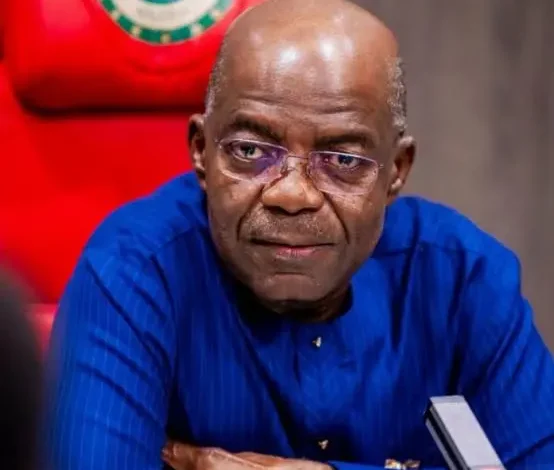
Abia State Governor Alex Otti has said he has no intention of becoming a political godfather or imposing a preferred successor on the people of the state after completing his tenure.
Otti made the declaration in Umuahia while receiving Ngozi Johnson-Chukwunenye, the former Social Democratic Party governorship candidate, and her supporters into the Labour Party.
The governor said political succession in Abia should be based on the ability and suitability of candidates rather than an arrangement where a sitting leader attempts to control the state’s political leadership indefinitely.
He said he does not support the idea of political godfathers controlling the affairs of government or determining who occupies political offices behind the scenes.
Otti stated that when the time comes to choose his successor, the focus should be on identifying the person considered most capable of providing effective leadership to Abia.
He also said he would not seek another elective position after completing his second tenure in 2031, maintaining that leadership should not become a permanent occupation for one individual.
According to him, the state has younger people who are better trained and equipped to take over leadership responsibilities, and they should be given opportunities to contribute to the future of Abia.
The governor said his administration was already taking steps to prepare younger people for leadership through initiatives such as the Abia Leadership Academy.
He disclosed that more than 1,080 young people between the ages of 16 and 25 had recently completed training at the academy.
Otti said the programme was intended to expose young Abians to leadership and prepare them for responsibilities that would eventually be transferred from the current generation.
He argued that Abia should not operate under a political system in which one individual remains dominant indefinitely.
The governor also linked the issue of succession to the importance of good governance.
He said that once citizens experience effective administration and begin to see tangible improvements in their communities, they would be less willing to accept a return to what he described as poor governance.
Otti expressed confidence that the progress made under his administration would influence how Abians approach future elections.
He said his expectation was that whoever eventually succeeds him would be capable of improving on the work of his administration rather than simply serving as a political placeholder.
The governor’s comments come as political activities begin to intensify ahead of the 2027 general elections.
Although the governorship election in Abia will not determine Otti’s immediate successor because he is constitutionally eligible to serve a second term, the governor’s comments have already drawn attention to what could happen after his tenure ends.
Otti has maintained that he intends to concentrate on governance rather than creating a political structure designed to keep him influential after leaving office.
His comments also come amid increasing discussions across Nigerian states about political succession and the influence of former governors on their successors.
In several parts of the country, former governors have remained influential after leaving office, sometimes continuing to play significant roles in determining candidates and political appointments.
Otti’s latest position sets out a different approach, with the governor saying the process should ultimately focus on the candidate considered most suitable for the job.
He said political leaders should be prepared to step aside and allow younger generations to emerge.
The governor also defended his administration’s ongoing development programme, acknowledging that there had been criticism but arguing that large-scale development could not be completed overnight.
He said the government had initially concentrated on restoring infrastructure and improving conditions in Aba and Umuahia before expanding its interventions to other parts of the state.
According to Otti, the administration was now extending development projects into communities in the hinterland and would continue doing so until the different parts of Abia received attention.
He said criticism would not prevent the government from continuing with its development plans.
The governor’s comments on political succession were made during an event that also marked the formal movement of Johnson-Chukwunenye and her supporters into the Labour Party.
Johnson-Chukwunenye, who contested the 2023 Abia governorship election on the SDP platform, said she decided to support Otti after observing what she described as the administration’s efforts to improve the state.
She cited projects and policies aimed at improving the appearance and infrastructure of Abia as factors influencing her decision.
She also called for legislation that would encourage continuity and completion of projects inherited from previous administrations, arguing that development should not stop whenever there is a change of government.
The move adds another dimension to the political realignment taking place in Abia ahead of the next electoral cycle.
The Labour Party leadership in the state also welcomed Johnson-Chukwunenye and her supporters, describing the growing support for the party as connected to the administration’s performance.
The party has begun preparing its grassroots structures for future elections, with emphasis on mobilisation at polling-unit level.
For Otti, however, the larger message of his latest declaration is that political leadership should not be built around an individual or a permanent political network.
He said the state’s future should be determined by capable leaders who can continue to provide effective governance.
His comments also suggest that he wants the conversation about his eventual successor to focus on competence rather than personal loyalty.
The governor’s position is likely to remain part of political discussions in Abia as the 2027 election approaches and questions about the state’s future leadership become more prominent.
For now, Otti remains focused on completing his current term and seeking a second term, while insisting that he does not intend to become a political godfather or dictate who should govern Abia after his tenure.
He said the ultimate decision should involve assessing the available candidates and determining who is best equipped to lead the state.
The governor’s emphasis on younger leadership also places the development of political capacity among Abia’s youths at the centre of his long-term vision.
With more than 1,000 young people already reported to have completed the Abia Leadership Academy programme, the administration says it is creating a pool of young people who can eventually take on leadership responsibilities.
Whether that approach will translate into a different political succession model in Abia remains to be seen, but Otti has made his position clear: he says he does not want to control the state from behind the scenes after leaving office.