2027: Umahi Says South-East Presidency Will Come, But Insists It Is Not Yet the Region’s Turn

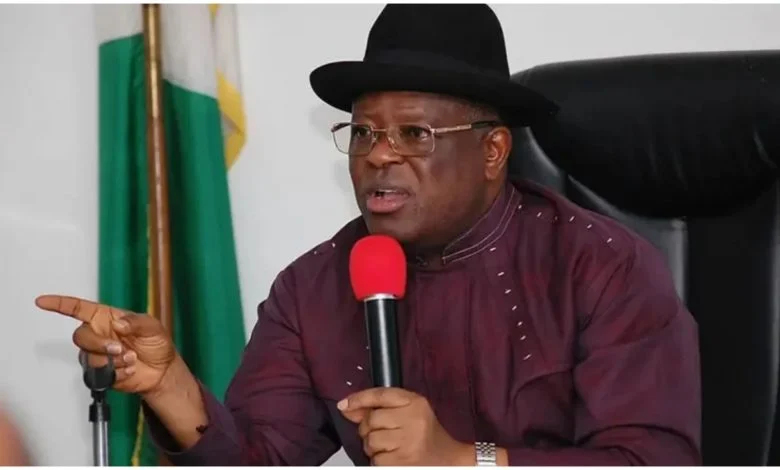
Minister of Works David Umahi has said the South-East will eventually produce a president of Nigeria but argued that the time has not yet arrived for the region to occupy the country’s highest political office.
Umahi made the statement in Benin City, Edo State, while speaking at an event focused on the Federal Government’s intervention on the Benin-Asaba Road.
His comments came amid growing political activity ahead of the 2027 presidential election and renewed debate over the possibility of an Igbo candidate emerging as Nigeria’s next president.
Umahi, a former governor of Ebonyi State, also addressed comparisons between himself and former Anambra State governor Peter Obi, who is preparing to contest the 2027 presidential election under the Nigeria Democratic Congress.
The Minister rejected suggestions that Obi was superior to him, arguing that any comparison between the two politicians should take into consideration their family backgrounds, intellectual capacity, records of public service and contributions to the South-East.
He questioned the basis for claims that Obi was beyond comparison with him and challenged those making such assessments to consider the records of both men.
Umahi also referred to their experiences as former governors of South-Eastern states, arguing that their performances and contributions to the region should form part of any assessment of their respective political records.
His remarks add another dimension to the political disagreement between supporters of President Bola Ahmed Tinubu and those backing Obi ahead of the 2027 election.
While Obi is seeking the presidency on the platform of the NDC, Umahi remains a member of the All Progressives Congress and has consistently defended the Tinubu administration.
The Minister has previously called on political and community leaders in the South-East to explain what he considers the achievements of the Tinubu administration in the region.
He has argued that the South-East should maintain engagement with the Federal Government and take advantage of projects, appointments and other opportunities provided by the administration.
Umahi’s latest position on the presidency is tied to that broader political argument.
He said there was no reason to believe that the South-East would permanently be excluded from producing a Nigerian president.
At the same time, he rejected the argument that 2027 should automatically be regarded as the South-East’s turn.
Instead, he said the current political moment belonged to President Tinubu and that the South-East would have its opportunity in the future.
The statement has renewed debate over the idea of rotational presidency, an informal political arrangement that has influenced discussions about presidential power among Nigeria’s major regions.
Supporters of rotation argue that allowing different regions to produce the president can promote inclusion and political balance.
Others maintain that presidential elections should primarily be determined by constitutional eligibility, political competition and the votes of Nigerians rather than an informal zoning arrangement.
The disagreement has become particularly significant in the South-East, where Obi maintains considerable political support and has positioned himself as a major opposition figure ahead of 2027.
Umahi’s comments therefore come at a time when different political groups are attempting to persuade voters in the region to support competing political strategies.
While Obi’s political campaign is seeking support for his presidential bid, Umahi has been advocating continued support for Tinubu and the APC administration.
The Minister has argued that the South-East should evaluate the Federal Government based on infrastructure projects, appointments and other developments rather than relying solely on political sentiment.
He has also defended the right of people from the region to support Tinubu without being accused of abandoning their ethnic or regional interests.
That argument has generated disagreements among political figures and supporters across the South-East.
For Umahi, supporting Tinubu is consistent with what he believes will bring practical benefits to the region.
For Obi’s supporters, however, the 2027 election represents an opportunity to pursue a different political direction.
The competing positions are expected to become more prominent as the election approaches and political parties intensify their mobilisation.
At the Benin City event, Umahi also defended members of the Tinubu administration who respond to criticism of the President.
He said those working with the President would not remain silent when the administration was challenged, particularly when they believed government programmes and projects were producing results.
The Minister’s remarks came alongside an update on the Federal Government’s plans for the Benin-Asaba dual carriageway.
He announced that the 136-kilometre road would be redesigned using reinforced concrete pavement following difficulties surrounding the continuation of the existing concession arrangement.
Umahi said the Federal Government had already begun temporary intervention work on parts of the road while a longer-term solution was being developed.
He also disclosed plans for immediate intervention on the Benin Bypass.
The road project formed an important part of the event because of its significance to transportation and economic activity between Edo and Delta states.
Umahi said the decision to redesign the road followed the failure of several options proposed for the continuation of the concession agreement.
The Federal Government’s intervention is expected to focus on improving the condition of the route while plans for the wider reconstruction are developed.
The Minister’s discussion of infrastructure also formed part of his broader defence of the Tinubu administration.
He has repeatedly argued that infrastructure projects should be considered when assessing the performance of the current government.
His political position has also placed him on the opposite side of Obi on the question of the 2027 presidency.
Obi’s campaign is seeking to build a national coalition for the presidency, while Umahi is advocating support for Tinubu’s re-election.
The disagreement is not simply about the personalities of the two politicians.
It also reflects different approaches to the question of how the South-East should participate in national politics.
One approach places emphasis on producing a president from the region, while another focuses on building alliances with the party controlling the Federal Government and seeking benefits through political participation within that structure.
As the 2027 election draws closer, both arguments are likely to receive greater attention among voters and political leaders.
The South-East will remain an important part of the national political conversation because of its voting population, economic influence and longstanding demand for greater representation at the federal level.
The region’s political leaders are divided over how that representation should be pursued.
Some have openly backed Obi’s presidential ambition, while others have aligned themselves with Tinubu and the APC.
Umahi’s latest statement makes clear that he belongs to the latter camp.
He maintains that the South-East will eventually produce the president but does not accept the argument that 2027 must be the region’s turn.
He has instead called for continued support for Tinubu, pointing to the administration’s infrastructure programme and other forms of federal engagement with the region.
The statement is likely to generate further reactions from Obi’s supporters and other political groups in the South-East.
With the 2027 election still ahead, the debate over zoning, regional representation, political alliances and individual candidates is expected to intensify.
For now, Umahi’s position is clear: he believes an Igbo presidency remains possible in the future but supports Tinubu for the current electoral cycle.
His comments have consequently added another voice to the growing political debate over who should lead Nigeria after the 2027 presidential election and what role the South-East should play in determining that outcome.