Senate Turns Down Nigeria Air Revival Proposal, Urges FG to Build a New National Airline

The Nigerian Senate has rejected a proposal seeking the revival of the controversial Nigeria Air project, while calling on the Federal Government to explore fresh options for establishing a viable national carrier that can represent the country in the international aviation industry.
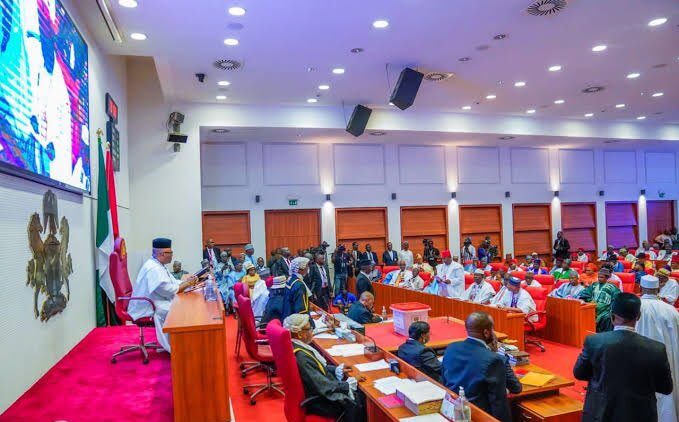
The decision followed deliberations during plenary on Tuesday, November 3, 2026, after lawmakers considered a motion on Nigeria’s Bilateral Air Services Agreement (BASA) with China.
Although senators dismissed the proposal to revive the failed Nigeria Air arrangement, they maintained that Nigeria still needs a national airline capable of flying the country’s flag and improving its participation in international air transportation.
Senate President Godswill Akpabio, who spoke during the debate, questioned the idea of bringing back an airline project that had already collapsed, describing further discussions about reviving the old arrangement as unproductive.
He, however, stressed that the country should not abandon the idea of having a national carrier.
Akpabio called on lawmakers to introduce a fresh motion that would allow the Federal Government to consider establishing a new Nigerian-owned airline under a different and more sustainable arrangement.
According to him, Nigeria needs an airline that can carry the national flag and provide reliable air transportation services to Nigerians travelling within and outside the country.
He recalled the operations of the former Nigerian Airways, noting that the airline once had a sizeable fleet and operated across several international destinations.
The Senate President expressed concern that Nigeria had moved from having a national airline with dozens of aircraft to a situation where the country depends heavily on private and foreign airlines for air transportation.
He also lamented the difficulties travellers and other Nigerians encounter when trying to secure aircraft, particularly during busy travel periods and political campaigns.
Akpabio pointed to the expected increase in air travel during the December festive season, expressing concern that existing private airlines might struggle to meet growing demand.
He argued that a functional national carrier could help address some of the challenges facing the aviation industry and provide additional options for Nigerian travellers.
The debate surrounding Nigeria Air was triggered by Senator Ned Nwoko, who proposed that the government should consider reviving the national carrier project.
However, the proposal was rejected by lawmakers, leading to discussions about the need to establish an entirely new airline rather than return to the previous arrangement.
Nigeria Air was originally introduced under the administration of former President Muhammadu Buhari as part of efforts to establish a national airline that would compete in the international aviation market.
The project was unveiled in May 2023, shortly before the end of Buhari’s administration, with Ethiopian Airlines expected to play a major role in its establishment and operations.
Under the proposed partnership structure, Ethiopian Airlines was expected to hold a significant stake, while the Federal Government and other Nigerian investors were also expected to participate.
However, the project soon became surrounded by controversy, with questions raised about its ownership structure, financial arrangements, transparency and the extent of foreign control.
The proposed airline was also challenged by domestic airline operators, who questioned aspects of the process through which the project was developed.
In August 2024, the Federal High Court in Lagos declared the proposed sale arrangement involving Ethiopian Airlines invalid and legally ineffective.
The controversy eventually led to the suspension of the project by the Federal Government.
Former Aviation Minister Festus Keyamo had also raised concerns about the terms of the proposed partnership, arguing that some of its financial and management provisions were not favourable to Nigeria.
The abandoned project has remained a subject of political and public debate, particularly because of the amount of attention and resources devoted to the proposed national carrier.
The latest Senate decision therefore signals a preference for a fresh approach rather than attempting to revive the previous Nigeria Air arrangement.
Beyond the national carrier debate, lawmakers also considered the imbalance in air transportation between Nigeria and China.
The substantive motion was sponsored by Senate Chief Whip, Senator Tahir Monguno, who called for the renegotiation and enforcement of the Bilateral Air Services Agreement between both countries.
Monguno argued that Nigerian airlines should enjoy reciprocal access to operate direct flights to China, just as Chinese airlines operate direct services into Nigeria.
He explained that the absence of direct flights by Nigerian carriers creates additional difficulties for Nigerian traders, businesspeople and other travellers visiting China.
Many passengers travelling between the two countries are required to connect through other international destinations, increasing travel time and potentially adding to transportation costs.
The senator said enforcing the agreement could strengthen trade relations, improve business activities, reduce unnecessary travel delays and create additional opportunities for Nigerian airlines.
He also noted that stronger direct air connections could improve the movement of goods, support small and medium-sized businesses and encourage the export of Nigerian products to international markets.
Other senators who contributed to the debate expressed concerns about the benefits Nigeria receives from its economic relationship with China.
Senator Abdul Ningi questioned whether Nigeria was obtaining sufficient advantages from the relationship, considering the country’s economic importance and the volume of trade between both nations.
Akpabio also expressed dissatisfaction with an arrangement that allows Chinese airlines to operate directly into Nigeria without corresponding opportunities for Nigerian carriers to fly directly to China.
He warned that Nigeria might need to reconsider some of the privileges currently enjoyed by Chinese airlines if Nigerian operators continued to face restrictions in accessing the Chinese market.
Following the debate, the Senate urged the Ministry of Aviation and Aerospace Development to renegotiate the agreement and work towards establishing direct commercial air connections between Nigeria and China.
The Ministry of Foreign Affairs was also asked to begin diplomatic discussions with Chinese authorities on facilitating business visas for Nigerian traders and securing reciprocal airport slot allocations.
The Senate further directed its Committees on Aviation and Foreign Affairs to monitor the implementation of the resolutions and report back within four weeks.
The development places two important issues before the Federal Government: the need to establish a sustainable national airline and the demand for fairer access for Nigerian aviation operators in international markets.
For Nigeria’s aviation industry, a national carrier could potentially improve international connectivity, create employment opportunities and provide additional competition in the market.
However, establishing such an airline would require careful planning, sufficient investment, transparent ownership arrangements, professional management and a business model capable of remaining financially sustainable.
The collapse of previous national airline arrangements has demonstrated the importance of addressing these issues before committing public resources to another project.
As the Senate pushes for a fresh national carrier initiative, attention will now turn to the Federal Government and the Ministry of Aviation to determine what approach could deliver a viable airline without repeating the problems associated with the previous Nigeria Air project.