
India’s Fertility Rate Drops Below Replacement Level, Raising Long-Term Concerns.

India’s fertility rate has dropped to 1.9 children per woman, with consequences for its workforce, elders and economy.
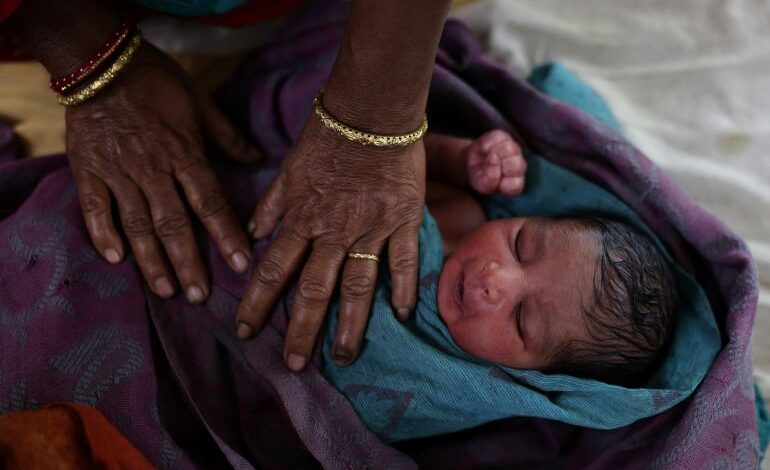
A nurse cares for a newborn baby at a hospital in Kishanganj district in Bihar state [File: Anushree Fadnavis/Reuters]
India has recorded a fertility rate below the replacement level for the first time, a development that signals a major shift in the country’s population pattern and has sparked fresh discussion among demographers and policy experts.
Reports referenced around June 9, 2026, indicate that the average number of children per woman in India has fallen below 2.1, the benchmark needed for a population to remain stable without declining over time.
Experts say the drop is the result of several overlapping social and economic changes. These include increased access to education, especially for women, rising living costs in urban areas, delayed marriage patterns, and greater use of family planning services across both cities and rural communities.
India, long regarded as one of the youngest and fastest-growing populations in the world, is now entering a new demographic phase. Analysts note that while the country still has a large youth population, the pace of new births is slowing, which could gradually reshape its population structure over the coming decades.
The trend is not uniform across the country. Some states, including Kerala and Tamil Nadu, have been below replacement level for years, while other regions continue to record higher birth rates. This uneven pattern has raised questions about future regional balance in population distribution and development planning.
Demographers warn that if the decline continues, India could eventually face challenges linked to an ageing population, including pressure on healthcare systems, pension structures, and a shrinking workforce in the long term.
At the same time, some economists argue the shift could bring benefits if managed well, such as improved access to resources, better education outcomes, and higher productivity per worker.
Although Indian authorities have not announced any urgent policy changes in response to the latest figures, population planning programs and health initiatives remain in place to support maternal care and reproductive health services.
Globally, India now joins a list of countries experiencing sustained fertility decline, a trend already seen in parts of East Asia and Europe, where governments have been adjusting policies to respond to similar demographic shifts.
Experts say the full impact of this development will not be immediate but will unfold gradually over decades, making early planning and policy adjustment essential for long-term stability.
Further analysis of India’s demographic shift suggests that the decline in fertility rate is closely linked to changing lifestyle patterns, particularly in urban centres where education levels and career priorities have significantly reshaped family planning decisions.
Sociologists note that younger generations are increasingly prioritising financial stability, housing, and employment security before starting families, which has contributed to a steady reduction in birth rates across many metropolitan areas such as Delhi, Mumbai, Bengaluru, and Chennai.
In rural regions, where fertility rates were traditionally higher, access to healthcare, awareness campaigns, and government-led family planning initiatives have also played a role in gradually reducing birth numbers over time. Improved infant survival rates have further influenced family size decisions among households.
Population experts say this transition places India at a critical demographic turning point, where the country may begin to experience a slowdown in population growth earlier than previously projected. This shift is being closely monitored by economic planners, who rely on population growth forecasts for long-term infrastructure, education, and labour market planning.
There are also concerns about future workforce distribution. Analysts warn that as the proportion of working-age citizens stabilises and eventually begins to decline, India may need to focus more heavily on automation, skill development, and productivity-driven economic models to sustain growth.
Some researchers have pointed out that similar demographic patterns have already been observed in countries like Japan and South Korea, where low fertility rates have led to shrinking populations and increased reliance on technology and immigration to support labour demands.
Despite these concerns, India still maintains a relatively young population compared to many developed nations, meaning the immediate effects of the fertility decline are expected to remain limited in the short term.
Government policy discussions are expected to increasingly focus on balancing population stabilisation with economic development, particularly as data from future censuses and surveys provide clearer insights into long-term trends.
For now, experts say the development marks not a crisis, but a significant transition—one that will require careful planning, adaptive policy, and long-term demographic strategy.
As discussions on India’s falling fertility rate continue, attention is also shifting toward how regional inequalities may shape the country’s future demographic balance. States that have already recorded long-term low fertility levels are expected to age faster, while higher-fertility regions may continue to supply a larger share of the national workforce in the coming decades.
Public health experts point out that improvements in maternal healthcare, vaccination coverage, and child survival rates have significantly reduced the need for larger families, especially compared to previous generations where higher infant mortality rates influenced family size decisions.
Urban planners are also beginning to factor demographic slowdown into long-term infrastructure development strategies. In several major cities, projections are being adjusted to account for slower population growth, changing housing demands, and evolving labour market needs.
Economists say the shift could also reshape consumption patterns, as smaller household sizes tend to influence spending behaviour, savings rates, and demand for education, healthcare, and housing services. These changes may gradually affect both domestic markets and foreign investment strategies in India.
At the policy level, experts suggest that India may increasingly focus on improving workforce productivity rather than relying on population growth as the main driver of economic expansion. Investments in technology, automation, and skills development are being seen as key tools to offset the impact of slower population growth.
Meanwhile, international observers continue to monitor India’s demographic transition closely, given its global significance as the world’s most populous nation. Any long-term slowdown in population growth is expected to have wide-ranging effects not only domestically but also on global labour markets and economic trends.
While the country’s current population remains large and youthful compared to many others, analysts agree that the fertility rate decline marks a clear turning point in India’s demographic journey—one that will gradually reshape its future over the coming decades rather than immediately.