
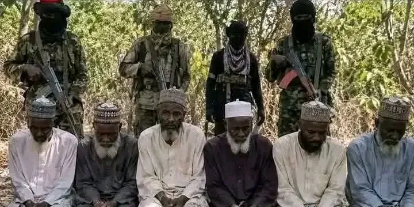
Six Islamic clerics abducted in Zamfara State are reportedly being held by bandits who have demanded N30 million for their release, raising fresh concerns over the security situation in the state.
The clerics were kidnapped while travelling through Bakura Local Government Area of Zamfara on their way to Talata Mafara, where they were expected to attend a gathering connected to prayers for President Bola Ahmed Tinubu ahead of the 2027 presidential election.
The development has attracted renewed attention because of the circumstances surrounding the journey and the fact that the victims were religious leaders travelling together when their vehicle was intercepted by armed men.
The clerics were reportedly travelling along the Dakko-Damri route when the attackers stopped their vehicle and took them away.
The incident was initially surrounded by conflicting reports about where the abduction occurred. Early accounts suggested that the clerics had been taken from a prayer gathering at the residence of Senator Abdulaziz Yari in Talata Mafara.
Subsequent reports, however, indicated that the six clerics were intercepted on their way to the gathering rather than being abducted directly from Yari’s residence.
The clarification placed the reported attack along a feeder road in the Bakura area, highlighting the security risks faced by travellers who use less busy routes to avoid attacks on major highways.
Eight people were reportedly taken during the incident.
The victims included the six clerics, their driver and two other individuals who were returning from a farm in the area.
The two farm workers were reportedly released after their abductors demanded N300,000 from each family as well as two 25-litre containers of petrol.
The driver was also reportedly released after his family paid N2 million to the abductors.
The six clerics, however, remained in captivity, with their abductors reportedly demanding N30 million for their freedom.
The development has heightened anxiety among the families of the religious leaders, who are said to be hoping for their safe return.
The clerics were identified as Malam Muhammadu Shehu, the Chief Imam of Dakko Juma’at Mosque; Malam Murtala Dakko, the Deputy Imam of Dakko Juma’at Mosque; Malam Muhammad Yahuza, the Chief Imam of Dogon Madacci First Juma’at Mosque; Malam Magawata Abdullahi, the Chief Imam of Dogon Madacci Second Juma’at Mosque; Malam Bala Hogun, the Chief Imam of Hogun Juma’at Mosque; and Malam Muhammad Tasi’u, the Chief Imam of Kwatsama Juma’at Mosque.
The reported ransom demand has added another dimension to the continuing kidnapping crisis in Zamfara, where criminal groups have frequently targeted travellers, farmers and residents of rural communities.
The state’s difficult security environment has forced many residents to change their travel patterns, with some reportedly avoiding major roads because of the fear of attacks.
However, the use of alternative feeder roads has also exposed travellers to new risks because such routes are often isolated and may have limited security presence.
The latest incident illustrates the challenge facing communities attempting to balance movement with personal safety.
For the families of the six clerics, the immediate priority remains their safe return.
Reports indicate that efforts are being made to raise the ransom demanded by the abductors, although the circumstances surrounding any proposed payment remain unclear.
There are also reports that a serving senator from Zamfara has indicated a willingness to assist with the ransom, but the details and status of any such intervention have not been independently established.
The reported demand has also renewed calls for security agencies to intensify efforts to locate the victims and rescue them.
Residents have expressed concern about the vulnerability of religious leaders and other community figures who regularly travel between villages and towns.
The clerics’ reported abduction also comes at a sensitive time politically, given that their journey was connected to a prayer gathering linked to Tinubu’s 2027 re-election campaign.
The political nature of the gathering has attracted attention, but there is no indication from the available reports that the clerics were targeted because of their political activities.
The available accounts instead describe the incident as a kidnapping carried out by armed bandits operating along the route.
The situation nevertheless demonstrates how insecurity can affect political, religious and community activities in areas where armed criminal groups maintain a presence.
Zamfara has remained one of the states most affected by banditry and mass kidnapping, with rural communities frequently facing attacks and demands for ransom.
The continued targeting of travellers has also created economic consequences.
Farmers who cannot safely travel to their fields may lose access to their livelihoods, while traders and other residents may be forced to spend more money on transportation or security arrangements.
The fear of abduction can also discourage people from travelling between communities, affecting trade, education, healthcare access and other essential activities.
For religious leaders, movement between communities is often necessary because of Friday prayers, religious ceremonies, community meetings and other activities.
The reported kidnapping therefore goes beyond the immediate victims and raises concerns about the safety of people performing important community roles.
The case has also revived the debate over ransom payments.
Families of kidnapped victims often face extremely difficult choices when abductors demand money for release.
While paying ransom may provide a possible route to securing the immediate release of a loved one, repeated ransom payments can also encourage criminal groups to continue kidnapping because they view abductions as a source of income.
Security agencies have repeatedly urged Nigerians to cooperate with authorities and provide information that can assist in rescue operations.
However, families frequently find themselves under enormous pressure when abductors establish deadlines or threaten to harm victims.
The reported N30 million demand has therefore placed considerable pressure on the families of the six clerics, particularly given the economic difficulties faced by many households.
There are also concerns about the health and psychological condition of the victims.
The clerics are reportedly older men, and prolonged captivity in difficult conditions could expose them to physical and emotional distress.
Relatives have consequently called for urgent efforts to secure their release and prevent further deterioration in their wellbeing.
The abduction has once again drawn attention to the need for stronger security coverage along rural routes in Zamfara.
Improving surveillance, strengthening intelligence gathering and increasing security presence on vulnerable roads could help reduce the ability of criminal groups to operate freely.
Community cooperation is also considered important because residents are often familiar with the movements of armed groups and may possess information that could assist security agencies.
At the same time, authorities face the challenge of protecting informants and communities that provide intelligence, particularly in areas where criminal groups have demonstrated the ability to retaliate against residents.
The reported kidnapping of the clerics therefore represents another difficult test for security agencies operating in Zamfara.
Their safe recovery would provide relief to their families and community members while also demonstrating the ability of authorities to respond to kidnapping incidents.
For now, the six clerics remain at the centre of efforts to secure their release, while their families await further developments.
The N30 million ransom demand has not been independently verified by the security authorities in the reports reviewed, and the identities and activities of the abductors remain under investigation.
What is not in dispute is that the reported abduction has added to the growing list of kidnapping incidents affecting communities in Zamfara and has once again highlighted the dangers faced by residents travelling through isolated areas.
As efforts continue to secure the clerics’ freedom, attention will remain focused on whether security agencies can locate the victims, identify those responsible and bring an end to the cycle of abductions and ransom demands affecting the state.