Troops Capture Suspected Terrorist Commanders Linked to Killing of Major General Rabe in Katsina

Nigerian troops operating in Katsina State have captured several suspected senior commanders of a terrorist group believed to have been involved in the kidnapping and killing of retired Major General Abubakar Rabe.
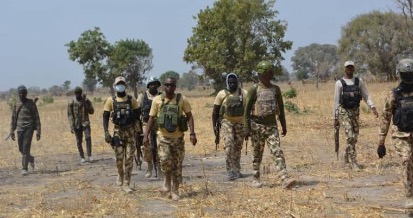
The arrests were made during an operation conducted by troops of Operation FANSAN YAMMA with support from local vigilantes as security forces intensified efforts to dismantle armed groups operating across parts of the North-West.
The suspects are reportedly members of a group identified as Kachalla Maha, a network accused of carrying out kidnappings, killings and other violent attacks in Katsina and neighbouring areas.
One of those captured was identified as Samagi, who is believed to hold a senior position within the group.
The operation is significant because of the reported connection between the group and the circumstances surrounding the death of Major General Rabe, whose killing had generated widespread concern within the military and across Katsina State.
Rabe, a retired senior military officer and former Director of Defence Information, was abducted in Katsina State while travelling with his wife. He subsequently died in captivity.
The killing of the former senior officer intensified concerns about the growing ability of armed groups in the North-West to target not only civilians but also serving and retired military personnel.
Security forces have since sustained operations aimed at locating members of the network believed to be responsible for the attack and other violent incidents in the region.
The latest operation reportedly involved detailed intelligence gathering and cooperation between conventional military forces and local vigilantes familiar with the difficult terrain where the suspected terrorists operate.
The involvement of local security personnel is particularly important in areas where terrorists and bandits frequently use forests, rural settlements and difficult-to-access locations as hideouts.
Local intelligence can assist security forces in identifying movement patterns, tracking suspected commanders and locating camps that may be difficult to detect through conventional patrols alone.
The capture of Samagi and other suspected commanders is expected to provide investigators with information that could help uncover the wider structure of the Kachalla Maha network.
Among the issues likely to be examined are the group’s leadership structure, sources of weapons and supplies, communication channels, hideouts and possible collaborators.
Investigators may also seek information about other kidnapping operations and attacks allegedly carried out by members of the group.
The suspects are expected to undergo further questioning and profiling as security agencies attempt to determine their individual roles and establish whether they were directly involved in the events surrounding Rabe’s abduction and death.
Although the suspects have been described as commanders linked to the group accused of the killing, their individual responsibility for the retired general’s death remains subject to investigation and due process.
The development comes months after Rabe’s death prompted renewed calls for stronger action against armed groups operating in Katsina and other parts of the North-West.
The retired general’s death was particularly significant because of his long military career and his previous role as Director of Defence Information.
His death also highlighted the vulnerability of retired security personnel who may no longer have access to the level of protection available to serving officers.
Following his death, military authorities assured his family that efforts would be made to identify and bring those responsible to justice.
The latest arrests indicate that the investigation and wider military operations against the suspected network have continued.
Security forces are also expected to use information obtained from the arrested suspects to identify additional members of the group.
The operation reflects a broader strategy increasingly being adopted against terrorist and bandit networks in the North-West, where intelligence-led operations are being combined with ground assaults and community-level information gathering.
For years, Katsina and neighbouring states have faced attacks involving kidnapping for ransom, cattle rustling, village raids and other forms of armed violence.
Criminal groups have exploited vast forest areas and difficult terrain to establish hideouts and move between communities.
The security challenge has therefore required sustained operations rather than isolated raids.
Military formations operating under Operation FANSAN YAMMA have continued to conduct operations aimed at denying armed groups freedom of movement and disrupting their ability to organise attacks.
The latest arrests could potentially weaken the command structure of the Kachalla Maha group if the individuals captured are confirmed to occupy senior positions within the organisation.
The loss of senior commanders can affect a criminal network’s ability to coordinate operations, communicate with fighters and organise kidnappings.
However, security experts and authorities typically face the challenge of ensuring that dismantling one part of a network does not simply lead to its members reorganising under new leadership.
For that reason, intelligence obtained from arrested suspects can be as important as the arrests themselves.
Information about supply routes, financiers, informants, weapons sources and communication channels could help security agencies target the wider network rather than focusing only on individual fighters.
The investigation could also help determine whether the same group has been responsible for other attacks that have occurred in Katsina and surrounding states.
The North-West security crisis has remained a major national concern, with armed groups continuing to exploit remote communities and vulnerable populations.
Kidnapping has also placed considerable pressure on families, businesses and local economies, as residents are forced to live with the fear of abduction and attacks.
The killing of a retired senior military officer further demonstrated the seriousness of the threat.
The latest operation therefore carries significance beyond the arrest of individual suspects.
It could become an important source of intelligence for understanding the activities of armed groups operating across Katsina and their connections with networks in neighbouring states.
The collaboration between troops and local vigilantes is another important aspect of the operation.
Community-based security groups often possess knowledge of local terrain and movement patterns that can complement military intelligence.
However, such cooperation also requires careful coordination to ensure that information supplied by local actors is properly verified before military action is taken.
The ultimate objective remains the protection of communities and the restoration of security in areas affected by persistent violence.
As the suspects undergo investigation, security agencies will be expected to establish the precise nature of their involvement in the Kachalla Maha network and determine whether they have direct links to the kidnapping and killing of Rabe.
Authorities will also be looking for information that could lead to the arrest of other members of the group.
The operation is therefore likely to continue beyond the initial arrests, particularly if intelligence obtained from the suspects points investigators towards additional hideouts or commanders.
The military has yet to provide a full public account of the operation, including the exact number of commanders captured, the weapons or other items recovered and the precise circumstances of the arrests.
Those details could provide a clearer picture of the scale of the operation and the significance of the suspects within the alleged terrorist network.
For now, the capture of several suspected senior members represents another development in the continuing military campaign against armed groups in Katsina.
It also offers investigators a potential opportunity to gain deeper insight into the network accused of participating in the abduction and killing of Major General Rabe.
As security operations continue across the North-West, authorities face the task of converting the latest arrests into actionable intelligence capable of identifying other members of the network, disrupting their operations and preventing further attacks on civilians and security personnel.
The case surrounding Rabe’s death remains a reminder of the devastating impact of terrorism and kidnapping on both communities and the security forces tasked with protecting them.
With the latest suspects now in custody, attention will turn to the investigation, the information they provide and whether the operation eventually leads security agencies to other individuals allegedly involved in the deadly network.