
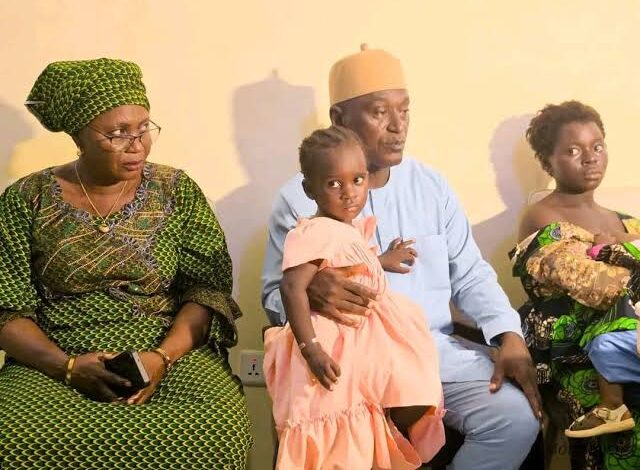
A 23-year-old Nigerian woman who survived an alleged human trafficking ordeal has been rescued from Burkina Faso alongside her three children and reunited with her family in Nigeria.
The woman, identified as Miracle Musa, was reportedly brought back to Nigeria after spending time in Burkina Faso, where she was allegedly subjected to exploitation and difficult living conditions.
The rescue has brought renewed attention to the dangers faced by Nigerians who travel to other countries after being promised employment, business opportunities or better living conditions, only to find themselves trapped in exploitative situations.
Miracle’s case is particularly significant because she was rescued together with her three children, meaning the intervention involved not only the recovery of a trafficking survivor but also the protection and repatriation of children who had been living with her outside Nigeria.
The circumstances surrounding her movement to Burkina Faso and the nature of the alleged exploitation are still being addressed as she begins the process of returning to normal life.
Her rescue also highlights the complicated situations that can arise when trafficking survivors have children while living under difficult or exploitative circumstances.
For families involved in such cases, returning home can require more than simply arranging transportation across the border.
Survivors may need medical attention, psychological support, documentation, accommodation and assistance with reintegration into their communities.
Children returning from trafficking situations may also require specialised care, particularly where they have experienced neglect, instability or other forms of hardship.
Miracle’s case comes amid continuing concerns over human trafficking across West Africa, where criminal networks exploit vulnerable people by promising legitimate jobs and improved opportunities.
Young women are particularly vulnerable to deceptive recruitment schemes, especially when they are offered work outside Nigeria without adequate information about their employers, destinations or working conditions.
Some victims travel willingly at the beginning of the journey because they believe they are accepting genuine employment opportunities.
The situation can become very different after they arrive at their destination, particularly when traffickers take control of their documents, movement or finances.
Victims may then find themselves unable to leave without assistance.
The rescue of Miracle and her children therefore underscores the importance of verifying overseas employment offers before travelling.
Individuals considering such opportunities are encouraged to confirm the identity of recruiters, employers and agencies, understand the terms of employment and ensure that their travel arrangements are properly documented.
Families also have an important role to play by maintaining communication with relatives travelling abroad and taking immediate action when contact is suddenly lost or circumstances appear suspicious.
Human trafficking remains a complex crime because victims can be recruited through seemingly ordinary channels.
Recruiters may present themselves as agents, employers, friends or acquaintances offering assistance with travel and employment.
In some cases, victims may even know the people involved in their recruitment, making it difficult for them to recognise the danger before leaving the country.
Once abroad, however, victims can become dependent on the people who arranged their journey.
This dependence can make escape extremely difficult, particularly when the victim has limited knowledge of the local language, lacks money or documentation, or fears retaliation.
For survivors who have children, the situation can become even more complicated because decisions about leaving an abusive or exploitative environment may also involve the safety and welfare of their children.
Miracle’s return with her three children means that the family can now begin the process of rebuilding their lives in Nigeria.
The successful rescue also demonstrates the importance of cooperation between Nigerian authorities, agencies working against trafficking and partners in destination countries.
Cross-border trafficking cannot easily be addressed by one country acting alone.
Recruitment may take place in Nigeria, transportation may pass through several countries and exploitation may occur somewhere else.
Effective intervention therefore requires information sharing, investigations, victim identification, safe repatriation and prosecution of those responsible.
The rescue of trafficking victims is only one part of the fight against the crime.
Authorities must also investigate trafficking networks and identify recruiters, transporters, facilitators and other individuals who profit from the exploitation of victims.
Strong prosecution is important because trafficking networks can continue operating if those responsible are not held accountable.
At the same time, survivors need to be treated as victims of crime rather than as offenders.
This is particularly important in cases where victims may have been forced to participate in activities against their will.
A survivor who has spent months or years under the control of traffickers may require considerable support before being able to regain financial independence and rebuild relationships with family members.
For children rescued alongside trafficking survivors, reintegration can also be challenging.
They may have spent significant periods away from relatives, schools and familiar communities.
Authorities and support organisations therefore have a responsibility to assess their needs and ensure that their return is handled in a safe and sensitive manner.
The case has also renewed attention on the role of poverty and unemployment in creating vulnerability to trafficking.
Many young Nigerians searching for opportunities are attracted by promises of well-paying jobs abroad.
When legitimate employment opportunities are difficult to find at home, fraudulent recruiters can exploit the desire for a better life.
This makes job creation and public awareness important components of the fight against human trafficking.
Young people need access to accurate information about the risks associated with unverified overseas employment offers.
They also need safe channels through which they can confirm whether recruitment companies and employment opportunities are legitimate.
Community awareness can help prevent potential victims from accepting offers that appear attractive but contain hidden dangers.
Parents and relatives should also be encouraged to take warning signs seriously.
Sudden requests for money, unexplained changes in communication, restricted access to a person’s phone or documents and inconsistent information about employment can all warrant further investigation.
In cases where someone is already believed to be trapped abroad, families should seek assistance through recognised authorities rather than attempting dangerous rescue efforts themselves.
The safe return of Miracle and her children is therefore an important development for the family and another reminder of the human cost of trafficking.
Behind trafficking statistics are real people whose lives can be severely disrupted by exploitation.
Survivors may lose years of education, employment opportunities, relationships and financial stability while living under the control of traffickers.
The psychological consequences can also continue long after the person has returned home.
For Miracle, returning to Nigeria with her children offers an opportunity to begin rebuilding her life with the support of her family and relevant institutions.
The next stage will be ensuring that the family receives whatever medical, psychological, social and economic support may be necessary.
The case also reinforces the need for stronger cross-border efforts to identify and dismantle trafficking networks operating between Nigeria and other West African countries.
As authorities continue working to prevent trafficking, the experience of survivors can help expose the methods used by recruiters and traffickers.
Their stories can also help potential victims recognise warning signs before they become trapped.
The rescue of the 23-year-old woman and her three children is ultimately a reminder that human trafficking is not simply an immigration issue.
It is a serious crime involving exploitation, abuse and the violation of basic human rights.
Protecting vulnerable people requires stronger prevention, rapid intervention when victims are identified, effective prosecution of traffickers and long-term support for survivors.
For Miracle and her children, the journey home marks the beginning of a new chapter after an ordeal that allegedly placed their safety and wellbeing at risk.
Their successful return offers hope that other Nigerians trapped in similar situations can also be identified, rescued and reunited with their families.