
Explosions Shake Damascus During French President Emmanuel Macron’s Historic Visit, Raising Fresh Security Concerns

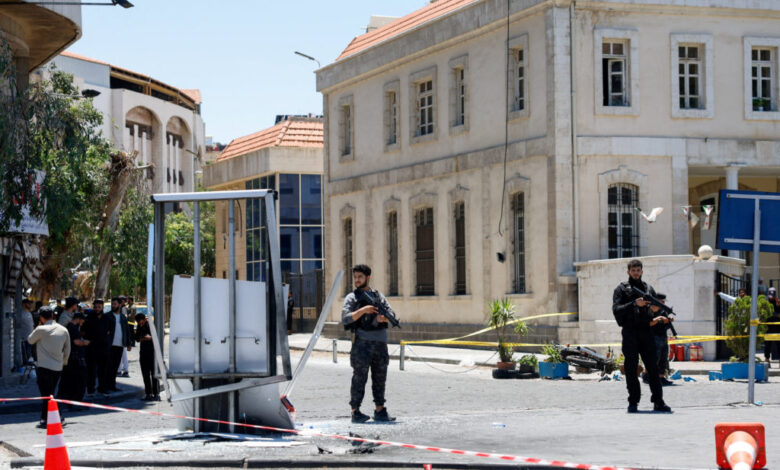
Syria’s capital, Damascus, was thrown into a state of heightened alert after a series of explosions struck parts of the city during the official visit of French President Emmanuel Macron, casting a shadow over what had been regarded as one of the most significant diplomatic engagements involving Syria in recent years.
The incident unfolded while President Macron was holding high-level meetings with Syria’s transitional leadership, a visit widely viewed as an important step toward rebuilding diplomatic engagement between France and Syria after years of political isolation, civil conflict, and regional instability.
The explosions, which echoed across sections of the capital, immediately prompted a large-scale security response as emergency services, firefighters, and security personnel rushed to the affected areas. Thick plumes of smoke were seen rising into the sky, while residents reported hearing powerful blasts that sent shockwaves through nearby neighborhoods.
Authorities swiftly sealed off roads leading to the explosion sites as investigators began gathering evidence to determine the exact nature and cause of the incident. Security checkpoints across Damascus were reinforced, with additional military personnel deployed around strategic government buildings, diplomatic facilities, transportation hubs, and other sensitive locations.
Despite the explosions, Syrian officials confirmed that President Macron and members of the French delegation were not harmed. Security teams responsible for protecting the visiting head of state immediately reviewed existing security arrangements, while officials insisted that the diplomatic programme continued under enhanced protective measures.
The visit itself had been expected to mark a new chapter in relations between Paris and Damascus, with discussions centered on regional stability, humanitarian cooperation, reconstruction efforts, counterterrorism, economic recovery, and the gradual restoration of diplomatic engagement following years of strained relations.
Political observers described Macron’s presence in Damascus as symbolically significant, reflecting growing international interest in Syria’s political transition and ongoing efforts to stabilize the country after years of devastating conflict.
French officials have consistently maintained that any renewed engagement with Syria must prioritize long-term peace, national reconciliation, institutional reforms, and humanitarian assistance for millions of civilians affected by years of violence.
Syrian authorities, meanwhile, viewed the visit as an opportunity to demonstrate improving security conditions and strengthen international cooperation aimed at rebuilding the country’s economy and infrastructure.
The explosions, however, served as a stark reminder that although the intensity of the conflict has diminished considerably compared to previous years, serious security challenges continue to confront the country.
Analysts note that Syria remains vulnerable to isolated attacks carried out by extremist groups, armed factions, and other actors opposed to ongoing political developments.
While government forces have regained control over much of the country’s territory, security agencies continue to conduct operations aimed at preventing attacks capable of undermining public confidence and disrupting efforts toward national recovery.
Experts believe the timing of the explosions is particularly significant because they occurred during the visit of one of Europe’s most prominent political leaders.
According to regional security analysts, attacks coinciding with high-profile diplomatic events often seek to attract international attention while projecting an image of continued instability.
Such incidents may also be intended to discourage foreign investment, delay diplomatic normalization, or undermine confidence in the host government’s ability to guarantee security.
Security specialists emphasized that visiting heads of state typically travel with comprehensive protection involving both local and international security agencies.
These operations usually include advance intelligence gathering, route monitoring, aerial surveillance, coordinated emergency response plans, and continuous communication between multiple security institutions.
Although officials have not immediately identified those responsible for the explosions, investigations are expected to examine possible links to extremist organizations or other groups capable of carrying out attacks within the capital.
Forensic experts and intelligence agencies have begun reviewing evidence recovered from the blast sites while interviewing witnesses and analyzing surveillance footage collected from nearby locations.
Government authorities have appealed for calm, assuring residents that every available resource is being deployed to identify those responsible and prevent further incidents.
Residents of Damascus described moments of confusion immediately after the explosions, with many businesses temporarily closing as people sought safety indoors.
Emergency responders worked for several hours to secure affected areas, assist the injured, and assess the extent of damage to nearby buildings and vehicles.
Hospitals across the capital were placed on heightened alert as medical teams prepared to receive casualties, while civil defence personnel continued inspecting surrounding locations for any additional threats.
The incident has also attracted widespread international attention, with governments and diplomatic missions closely monitoring developments as information continues to emerge.
Many foreign policy experts believe the attack underscores the delicate balance facing Syria as it attempts to rebuild diplomatic relationships while simultaneously addressing persistent security concerns.
Despite recent improvements in several parts of the country, the legacy of years of conflict continues to influence the political, economic, and security environment.
Macron’s visit was expected to focus heavily on encouraging political dialogue, supporting humanitarian initiatives, promoting economic reconstruction, and discussing broader regional security challenges affecting the Middle East.
France has repeatedly emphasized the importance of preventing renewed instability while encouraging solutions capable of supporting long-term peace and sustainable development.
Analysts suggest that the discussions between French and Syrian officials are likely to continue despite the security incident, with both sides recognizing the importance of maintaining diplomatic engagement during periods of uncertainty.
Many observers argue that abandoning dialogue because of isolated security incidents would risk slowing international efforts aimed at promoting stability throughout the region.
The explosions have nevertheless reinforced calls for continued vigilance as Syria advances through its political transition.
Regional experts maintain that rebuilding public confidence requires not only diplomatic progress but also measurable improvements in internal security, law enforcement, and institutional capacity.
International organizations have similarly stressed that lasting peace depends upon a combination of political reconciliation, economic recovery, humanitarian assistance, and effective security governance capable of protecting civilians and preventing renewed violence.
As investigations continue, authorities remain determined to establish the full circumstances surrounding the explosions and bring those responsible to justice.
Meanwhile, the international community will be watching closely to see how Syria manages both the immediate security response and its broader diplomatic agenda following one of the most closely watched foreign visits to the country in recent years.
For now, the incident serves as another reminder that while Syria continues making efforts toward recovery and renewed international engagement, maintaining lasting security remains one of the country’s greatest challenges. The outcome of ongoing investigations and the resilience of diplomatic cooperation in the aftermath of the blasts are likely to shape regional discussions in the weeks ahead.j