
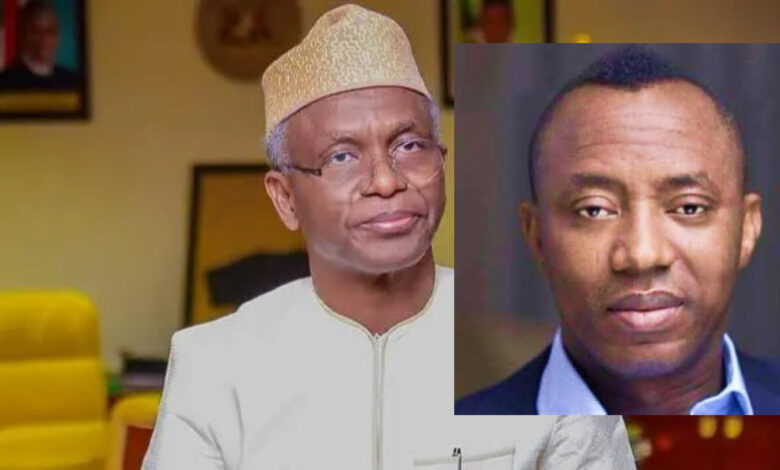
Human rights activist and former presidential candidate Omoyele Sowore has stirred fresh debate over the detention of former Kaduna State Governor Nasir El-Rufai, raising questions about the circumstances surrounding the case and the interests that may be involved.
Sowore’s latest comments have added another dimension to an issue that has already generated political controversy, with Nigerians closely following developments surrounding the former governor’s legal troubles.
El-Rufai, who governed Kaduna State from 2015 to 2023, has remained a prominent figure in Nigerian politics even after leaving office. His political influence, outspoken nature and role within the political establishment have continued to make developments involving him a subject of national interest.
The former governor has faced scrutiny and allegations relating to his period in office, while his supporters have consistently argued that he should be treated fairly and allowed to defend himself through due process.
Sowore, meanwhile, has questioned aspects of the situation and used the development to draw attention to what he sees as wider problems surrounding the use of state institutions against political figures and critics.
His comments have prompted renewed questions on social media, with some Nigerians asking whether El-Rufai’s detention is purely connected to ongoing legal investigations or whether political considerations could also be involved.
However, the questions remain largely within the realm of public debate, and claims about hidden motives would require credible evidence before they could be established as fact.
The controversy has become particularly sensitive because of the personalities involved and El-Rufai’s long political history.
As governor of Kaduna State, El-Rufai was known for making major policy decisions and maintaining a strong political presence. Before becoming governor, he served in senior government positions and played a significant role in Nigeria’s political affairs.
His supporters have argued that his prominence should not make him a target of politically motivated actions, while his critics maintain that former public officials must be accountable where there are credible allegations of wrongdoing.
The disagreement has created two competing narratives around the current situation.
One side sees the legal action against El-Rufai as part of a legitimate accountability process. The other questions whether political interests could be influencing the manner in which the former governor is being treated.
Sowore’s intervention has further amplified the second line of argument.
The activist has spent years criticising successive Nigerian administrations and security institutions, particularly over issues relating to human rights, freedom of expression, political repression and the treatment of detainees.
His own experiences with detention have also shaped his views on the Nigerian justice and security system.
Sowore has repeatedly argued that Nigerians should be concerned whenever state authorities restrict an individual’s liberty without sufficient transparency.
That position has now brought him into the wider conversation surrounding El-Rufai.
The case also raises broader questions about the powers of anti-corruption and law-enforcement agencies.
Such agencies have a responsibility to investigate allegations of corruption and other offences, but their activities must operate within the framework of the law.
Where an individual is detained during an investigation, questions about the legal basis for the detention, the duration of custody and access to legal representation can become important parts of the discussion.
These concerns become even more prominent when the person involved is a former governor or another high-profile political figure.
The public is often quick to interpret such cases through a political lens because Nigeria has a long history of political disagreements being intertwined with legal and corruption investigations.
Supporters of politicians facing investigation may describe the process as persecution, while political opponents may insist that the investigation is necessary for accountability.
Determining which interpretation is correct requires evidence, official records and, where necessary, judicial proceedings.
Sowore’s latest comments therefore raise questions that have attracted public attention, but they do not independently establish that a political conspiracy exists against El-Rufai.
The former governor himself and his legal representatives have also maintained positions regarding his treatment and the allegations surrounding him.
His legal team has challenged aspects of the proceedings and questioned the legality of certain actions taken against him.
Such challenges are important because they provide an avenue through which the courts can examine whether authorities have acted within their legal powers.
The judiciary ultimately has a significant role to play in determining whether allegations against a public figure are supported by evidence and whether the procedures used by investigators comply with the law.
The situation has also revived conversations about Nigeria’s approach to accountability after public office.
Former governors and other senior officials control significant public resources while in office, making it reasonable for their records to be scrutinised after leaving office.
At the same time, accountability must be applied consistently and without political discrimination.
The same standards should apply regardless of whether an individual belongs to the ruling party, an opposition party or has no active political affiliation.
This balance is at the centre of the wider debate surrounding El-Rufai.
For many Nigerians, the most important issue is not necessarily whether the former governor is politically popular but whether the allegations against him can be established through a transparent and credible process.
If there is sufficient evidence of wrongdoing, supporters of accountability argue that the law should take its course.
If the allegations cannot be substantiated, however, the accused should be entitled to the appropriate legal remedy.
The controversy has also highlighted the importance of avoiding the spread of unverified claims.
Political disputes can quickly become amplified on social media, where allegations can sometimes be presented as established facts before investigations or court proceedings have been completed.
This can create confusion and make it difficult for the public to distinguish between verified information, political commentary and speculation.
Sowore’s comments have consequently become another major talking point in an already complicated situation.
His supporters see his intervention as an important challenge to the government and a demand for transparency.
Those who disagree with him may argue that his criticism is politically motivated or that legal agencies should be allowed to carry out their duties without undue interference.
Meanwhile, El-Rufai’s political history ensures that the controversy is unlikely to disappear quickly.
The former governor remains a significant figure within Nigeria’s political landscape, and developments concerning him are likely to continue generating reactions from politicians, activists and members of the public.
The case also comes at a time when political tensions are increasing ahead of the 2027 general elections.
As politicians begin positioning themselves for the next electoral cycle, legal battles involving prominent political figures can easily become part of wider political narratives.
This makes transparency even more important.
Authorities involved in the case will likely face continued pressure to explain their actions and provide information that can reassure the public that the process is being conducted according to the law.
For El-Rufai, the focus remains on his legal situation and the allegations connected to him.
For Sowore, the matter represents another opportunity to challenge what he considers questionable use of government power.
For Nigerians, however, the most important question is whether the legal system will ultimately provide clear answers.
The public deserves a process in which allegations are properly investigated, evidence is presented and decisions are made according to established law rather than political pressure.
Until such evidence emerges, claims about who may be “behind” El-Rufai’s detention should remain allegations and not be treated as proven facts.
The unfolding controversy is expected to continue attracting attention as further statements, investigations and court proceedings provide more information about the former governor’s situation.
Ultimately, the credibility of the process will depend on whether Nigerians believe that the matter is being handled fairly, transparently and independently.
For now, Sowore’s intervention has ensured that questions surrounding El-Rufai’s detention remain firmly in the public conversation, with many Nigerians waiting for clearer answers about the legal circumstances behind the former governor’s detention and what the next stage of the case will bring.