
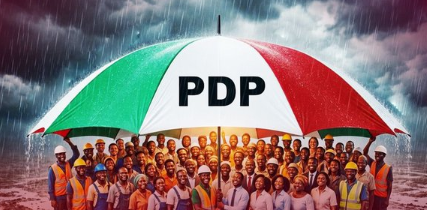
The Peoples Democratic Party has declared that it is fully prepared for the 2027 general elections, signalling its determination to remain a major force in Nigeria’s next electoral contest.
The party’s National Chairman, Abdulrahman Mohammed, gave the assurance as preparations for the 2027 elections continue to gather momentum across the country.
The declaration comes at a critical period for the PDP, which has spent considerable time rebuilding its structures and managing internal disagreements following a difficult period in the opposition party’s history.
Mohammed said the party remains committed to participating fully in the 2027 elections and described the PDP as a nationwide political organisation with structures extending across the 36 states, the Federal Capital Territory and the country’s 774 local government areas.
The chairman’s statement represents an attempt to project confidence and stability at a time when political parties are intensifying their preparations for the next electoral cycle.
For the PDP, the 2027 election presents an opportunity to rebuild its political influence after the party suffered significant setbacks during the 2023 general elections.
The party lost the presidency and also experienced a reduction in its representation in several political institutions.
Since then, internal disagreements over leadership, political alliances and the direction of the party have created challenges for its leadership.
The current leadership has therefore placed considerable emphasis on rebuilding the party’s structures and restoring confidence among its members.
Mohammed’s declaration that the PDP is ready appears aimed at reassuring members and supporters that the party intends to approach the 2027 contest as a serious challenger.
The party’s nationwide structure remains one of its major advantages.
Unlike smaller political organisations that may struggle to maintain an effective presence across the country, the PDP has established political structures at state, local government and ward levels.
Maintaining those structures will be crucial as the election approaches because grassroots mobilisation will play a major role in determining how effectively parties can reach voters.
The PDP chairman also pointed to the recent Osun governorship election as an indication of the continued strength of democratic participation in the country.
The election attracted considerable attention because of the competitive nature of the contest and the political significance of Osun State.
Although the PDP did not emerge as the eventual winner of the governorship contest, the election provided another opportunity for political parties to assess their structures, campaign strategies and level of grassroots support.
For the PDP, the lessons from the election could become useful as it prepares for the much larger national contest in 2027.
The party will need to translate its existing structures into an effective campaign organisation capable of competing with the ruling All Progressives Congress and other emerging political platforms.
The political environment ahead of 2027 is already becoming increasingly crowded.
The APC is seeking to retain control of the federal government, while opposition forces are attempting to build alliances capable of challenging the ruling party.
Several political figures who previously belonged to the PDP have also moved into other political platforms, creating additional challenges for the party.
Despite these developments, the PDP leadership appears determined to maintain the party’s identity and present it as a viable alternative to Nigerian voters.
One of the biggest tasks facing the party will be maintaining unity.
Political parties require internal cohesion to successfully contest national elections.
Disagreements over presidential candidates, zoning, leadership positions and the sharing of political responsibilities can quickly become major sources of conflict.
The PDP has experienced several such disputes in recent years, making reconciliation and internal discipline particularly important ahead of 2027.
The party will also need to strengthen its relationship with younger Nigerians.
Young voters represent a significant portion of Nigeria’s electorate and have become increasingly active in political discussions, particularly through social media.
The PDP has been attempting to increase youth participation within its structures, with party leaders calling for younger members to take greater responsibility in political mobilisation and leadership.
Women will also remain important to the party’s strategy.
Increasing the participation of women in party structures and candidate selection could help the PDP broaden its appeal and respond to demands for greater inclusion in Nigerian politics.
Beyond its internal organisation, the party will have to develop a clear message for voters.
Nigerians are expected to focus heavily on economic conditions, security, unemployment, inflation, infrastructure and the cost of living when making political decisions.
The PDP will therefore need to convince voters that it has practical solutions to the country’s most pressing challenges.
Simply criticising the ruling government may not be enough to win widespread support.
The party will have to present policies that voters can understand and believe are capable of improving their daily lives.
The choice of presidential candidate will also be crucial.
A candidate with strong national appeal, organisational capacity and the ability to unite different political interests could significantly influence the party’s chances.
The PDP will also have to ensure that its candidate-selection process does not trigger another round of internal disagreements.
The 2027 elections are expected to be particularly competitive, with several major political figures already positioning themselves for the contest.
The emergence of new alliances has also changed the traditional political calculations.
Some politicians who previously operated within the PDP have joined other platforms, while new coalitions are seeking to challenge the established political parties.
This means the PDP can no longer rely solely on its historical position as one of Nigeria’s two dominant political parties.
It must demonstrate that it can adapt to a changing political environment.
The party’s leadership will also need to strengthen its grassroots presence before the formal campaign period becomes more intense.
Effective mobilisation requires more than appointing party officials.
It involves maintaining active ward structures, engaging community leaders, registering and mobilising supporters and ensuring that the party’s message reaches voters across different parts of the country.
The PDP’s existing national structure gives it a foundation to build on, but that structure must remain active and properly coordinated.
The party will also have to address public perceptions about its years in government.
The PDP governed Nigeria at the federal level for 16 consecutive years before losing power in 2015.
Its record remains an important part of political debates, with supporters pointing to its achievements and critics highlighting shortcomings during its time in office.
Ahead of 2027, the party will need to convince voters that it has learned from its past mistakes and is prepared to offer a different approach to governance.
The coming months are therefore expected to be important for the PDP.
As political activity increases, the party will have to balance internal reconciliation with preparations for candidate selection and nationwide mobilisation.
Mohammed’s declaration that the party is ready sends a message of confidence, but the real test will come when the PDP begins translating that confidence into a coordinated national campaign.
The party’s ability to maintain unity, select popular candidates, mobilise voters and present a convincing policy agenda will determine how competitive it becomes.
For now, the PDP leadership insists that the party is prepared for the challenge.
With the 2027 election approaching, the party has an opportunity to rebuild its image, strengthen its structures and reconnect with Nigerians who may be searching for an alternative political direction.
Whether the PDP can successfully turn its organisational strength into electoral success will become clearer as the political season progresses.
For the opposition party, however, one message is already clear: it intends to enter the 2027 election as a serious contender and fight for a stronger political position across Nigeria.