
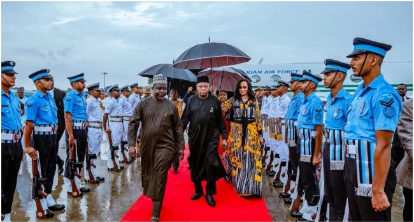
Vice President Kashim Shettima has arrived in New Delhi, India, as Nigeria seeks to deepen its engagement with the BRICS bloc and strengthen economic, trade and diplomatic cooperation with emerging global powers.
Shettima is leading Nigeria’s delegation to the 18th BRICS Leaders’ Summit, which is being hosted by India as the country holds the rotating chairmanship of the bloc.
His participation comes at a time when BRICS is placing greater emphasis on economic cooperation, alternative financial arrangements, trade, technology, infrastructure and stronger representation for developing economies in global institutions.
The summit is scheduled to bring together leaders and senior representatives of the expanded BRICS grouping in New Delhi, with discussions expected to focus on issues affecting the global economy and the interests of countries in the Global South.
Nigeria’s decision to participate at a high level reflects the country’s growing interest in strengthening relationships with emerging economies and expanding opportunities beyond traditional economic partners.
The Nigerian government has increasingly presented BRICS as an avenue through which the country can attract investment, expand access to international markets and participate more actively in discussions about the future of global economic governance.
Shettima’s visit is also taking place against the background of expanding India-Nigeria relations.
The two countries have maintained longstanding diplomatic and economic ties, with cooperation spanning trade, investment, healthcare, pharmaceuticals, education, technology, manufacturing and energy.
Recent engagements between Abuja and New Delhi have focused on strengthening the strategic partnership and increasing economic exchanges between the two countries.
Trade between Nigeria and India has grown substantially over the years, although both countries have continued to explore ways of expanding the volume and diversity of goods and services exchanged between them.
For Nigeria, deeper engagement with India could provide opportunities to attract investment into sectors identified as priorities under President Bola Ahmed Tinubu’s economic reform programme.
Areas such as manufacturing, agriculture, healthcare, digital technology, energy and infrastructure remain important to Nigeria’s economic development plans.
The government is also seeking to encourage more foreign investment as it works to diversify the economy and reduce excessive dependence on crude oil revenue.
The BRICS platform provides an additional avenue for Nigeria to engage with some of the world’s largest emerging economies.
The bloc has expanded considerably in recent years and now includes major economies such as Brazil, Russia, India, China and South Africa, alongside countries that joined during its recent expansion.
The enlarged grouping gives BRICS significant economic and demographic weight, with members accounting for a substantial share of the world’s population and global economic activity.
For Nigeria, participation offers an opportunity to strengthen relationships with countries that have large consumer markets, significant investment capacity and growing influence in international affairs.
The country is particularly interested in opportunities that can support industrialisation and infrastructure development.
Nigeria requires large-scale investment in electricity, transportation, housing, agriculture, telecommunications and manufacturing to meet the needs of its rapidly growing population.
Government officials have therefore continued to seek partnerships capable of providing both capital and technical expertise.
India is particularly relevant because of its experience in areas such as digital payments, pharmaceuticals, information technology and large-scale infrastructure development.
Indian companies already operate in Nigeria across several sectors, while Nigerian businesses have also maintained commercial relationships with Indian firms.
The two countries have the potential to expand this relationship further if investment barriers are reduced and trade becomes more diversified.
The BRICS summit also comes as the bloc considers ways to strengthen financial cooperation among its members.
BRICS finance ministers and central bank governors have recently pushed for reforms to international development institutions, including the International Monetary Fund and World Bank.
They have argued that the global financial system should better reflect the economic weight and interests of emerging markets.
The bloc is also discussing greater interoperability among payment systems and the development of faster and cheaper mechanisms for cross-border transactions.
India has been advocating for stronger digital payment cooperation among BRICS members, including discussions around linking central bank digital currencies.
Such developments could eventually create opportunities for countries like Nigeria to reduce some of the costs and complications associated with international payments.
For Nigerian businesses, easier cross-border transactions could support trade and investment with BRICS countries.
However, significant technical, regulatory and geopolitical challenges remain before a fully integrated BRICS payment system can become reality.
The different financial systems, currencies, regulatory environments and political interests of member countries make financial integration a complicated process.
Nigeria’s engagement with BRICS is therefore likely to focus primarily on practical economic opportunities rather than an immediate shift away from existing international financial relationships.
The country maintains extensive economic relationships with Western nations and international financial institutions, meaning its participation in BRICS does not necessarily represent a rejection of those relationships.
Instead, Nigeria has increasingly pursued a foreign policy approach that seeks partnerships across multiple centres of global power.
The strategy allows Abuja to engage with the United States, European countries, China, India, Russia and other major economies based on specific national interests.
Shettima’s presence at the summit is expected to reinforce that approach.
The Nigerian delegation is also expected to highlight the country’s investment potential and encourage greater private-sector engagement.
Nigeria’s large population provides a significant consumer market for foreign businesses, while its natural resources and strategic location make it attractive to investors seeking opportunities across Africa.
The government hopes that stronger diplomatic engagement can translate into concrete investment commitments and expanded commercial relationships.
Beyond economics, the summit provides Nigeria with an opportunity to participate in conversations about the future of global governance.
Developing countries have increasingly demanded greater representation in institutions responsible for making major international economic and political decisions.
Nigeria, as Africa’s most populous country and one of the continent’s largest economies, has consistently sought a stronger voice in global affairs.
Participation in BRICS discussions can therefore strengthen Nigeria’s ability to advocate for issues affecting developing countries.
The summit is taking place amid significant geopolitical tensions, including conflicts in Ukraine and the Middle East, growing rivalry between major powers and continuing disagreements over global trade and financial policies.
These tensions have increased the importance of platforms such as BRICS, where countries with different political and economic interests can negotiate areas of common concern.
However, the expanded bloc is not without internal disagreements.
Its members have different foreign-policy priorities and relationships with Western countries, making it difficult to reach agreement on some geopolitical issues.
Economic cooperation, infrastructure, trade, technology and development may therefore remain among the areas where practical cooperation is easiest to achieve.
For Nigeria, the challenge will be ensuring that participation in BRICS produces measurable benefits for the Nigerian economy.
The country needs investment that can create jobs, expand productive capacity and improve infrastructure rather than simply producing diplomatic engagements without significant economic outcomes.
The success of the visit will therefore be judged partly by the opportunities that emerge for Nigerian businesses, investors and government institutions.
If stronger partnerships are established with India and other BRICS members, Nigeria could potentially benefit from increased investment in manufacturing, agriculture, energy, healthcare and technology.
There may also be opportunities for Nigerian companies to access larger markets and develop partnerships with businesses across BRICS countries.
The visit comes as President Tinubu’s administration continues to promote economic reforms aimed at attracting investment and strengthening Nigeria’s position within the global economy.
Shettima has played a prominent role in representing the administration at international economic and diplomatic engagements, particularly those focused on investment and partnerships.
His participation in the BRICS summit is therefore another opportunity for Nigeria to communicate its economic priorities to a broad group of emerging economies.
As BRICS continues to expand its influence, Nigeria’s participation could also strengthen its position within the wider Global South.
For years, Nigeria has sought to maintain a leading role in African diplomacy while balancing relationships with competing global powers.
Closer engagement with BRICS could provide another platform through which Abuja can promote African economic interests and encourage investment into the continent.
The New Delhi summit is consequently expected to attract considerable attention from policymakers and business communities in Nigeria.
While the immediate outcome of the visit will depend on the discussions and agreements reached during the summit, the broader objective is clear: Nigeria wants stronger economic partnerships, greater investment opportunities and a more influential role in emerging global economic arrangements.
Shettima’s arrival in India marks the beginning of Nigeria’s participation in those discussions.
For the Tinubu administration, the BRICS engagement represents an opportunity to demonstrate that Nigeria intends to remain active in the changing global economic landscape and build partnerships wherever they can advance the country’s national interests.
The success of the strategy, however, will ultimately depend on whether diplomatic engagements translate into investment, trade expansion, technology transfer, job creation and tangible improvements in the Nigerian economy.