
Nigerian political history is replete with alliances that were publicly declared but quietly fell apart due to ego, financial disputes, and the basic incompatibility of interests that had been momentarily repressed in the quest for power.
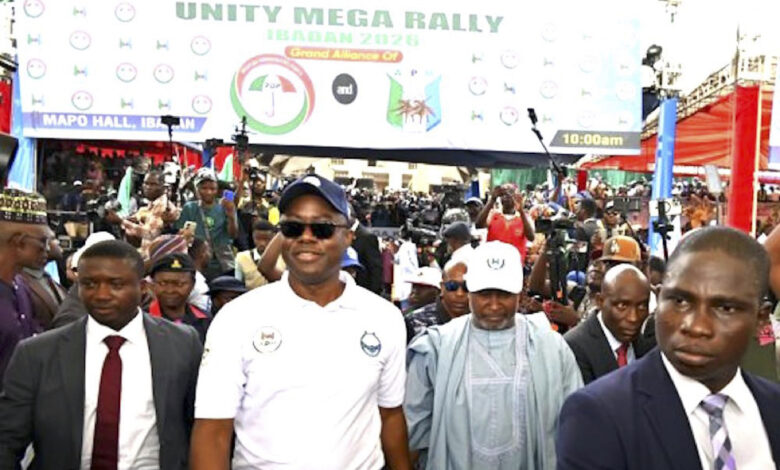
There are times in politics when the atmosphere of a single event captures something greater than itself, when a rally announces to anyone paying close attention that the national conversation has changed and transcends its immediate geography. This exact moment occurred last Thursday at the Mapo Hall Arcade in Ibadan.
Oyo State Governor Seyi Makinde did more than simply add his name to an already crowded opposition field when he announced his candidacy for president of the Federal Republic of Nigeria in front of thousands of supporters. He completely altered the nature of that field.
In order to fully understand Makinde’s actions, one must first understand the environment he has entered. In 2025, Nigeria is experiencing the cumulative effects of decades of governance that continuously promised change but consistently failed to deliver. Regardless of their long-term benefits, the Tinubu administration’s economic reforms have come at an exceptionally high short-term cost to common people.
All income levels have seen a decline in purchasing power due to inflation. In several states, food insecurity has reached crisis proportions. The reality of a difficult day has worn down the promise of a prosperous tomorrow. Up until now, the opposition has presented noise without coherence, complaints without a strong alternative, and aspirations without a face that can persuade Nigerian voters.
Makinde stands out from the throng of Nigerian politicians who have portrayed themselves as change agents for a devastatingly straightforward reason: he has made a real difference. In his seven years as Oyo State’s governor, he has overseen a change that his detractors have found genuinely hard to refute. Roads have been constructed. Schools have been restored. There has been observable and quantifiable investment in the Oyo State health sector.
Under his leadership, there has been a noticeable improvement in security, the most politically sensitive of all governance indices. Nigerian states have historically been administrative wards of Abuja rather than engines of their own development due to their reliance on federal allocations, which have decreased as the state’s internally generated revenue has steadily increased.
In the context of 2027, this is very important. Nigerian voters are no longer impressed by biography alone, especially the younger, more urban, and technologically savvy electorate that produced Peter Obi’s incredible 2023 performance. They’ve heard enough motivational personal stories. Evidence, proof that a candidate has turned the rhetoric of good governance into something a citizen can see, touch, or walk on, is what they are searching for. Makinde provides copious amounts of that evidence, which is the kind that withstands examination.
“The time to reset Nigeria is now,” he declared to the Ibadan crowd, and it wasn’t just a catchphrase. It was a claim supported by the track record of a man who has already reset one of the biggest and most complicated states in Nigeria. This distinction is not insignificant. It serves as the cornerstone around which a legitimate national campaign can be constructed.
Rather than being dismissed lightly, the merger of the Allied Peoples Movement and the Peoples Democratic Party bloc under the Reset Nigeria Movement banner merits careful consideration. Nigerian political history is replete with alliances that were publicly declared but quietly fell apart due to ego, money disputes, and the basic incompatibility of interests that had been momentarily repressed in the quest for power.
Makinde knows this background. Rather than leaving institutional bedrock to future negotiations, the two parties had already signed a formal Memorandum of Understanding prior to the Ibadan rally, indicating a seriousness of purpose that sets this coalition apart from its predecessors.
Ibadan’s geographical and political significance as the location of this proclamation is also noteworthy. This city has long been a test of Yoruba political consciousness and a gauge of sentiment toward the southwest. Makinde’s decision to start his national presidential campaign from Mapo Hall Arcade instead of Abuja, the traditional venue for federal political aspirations, conveys something intentional about the nature of his movement. Instead of gaining legitimacy from the corridors of power downward, he is grounding a national campaign in the sincerity of his own political base. That is a strategically wise decision in a political era characterized by public skepticism of elite consensus.
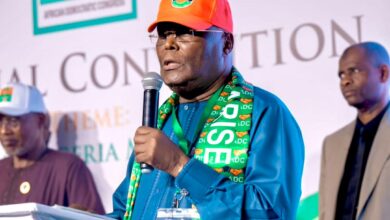
Makinde is now entering a genuinely complicated presidential field. After switching from the Labour Party to the Nigeria Democratic Congress, Peter Obi continues to enjoy strong urban support as well as the fervent allegiance of younger voters who see him as the true representative of their dissatisfaction with the two major parties. There is still legal and political uncertainty surrounding former President Goodluck Jonathan’s eligibility, and the outcome of an upcoming Federal High Court ruling could change the calculations of all other candidates.
The PDP itself is still internally split, unable to function as the disciplined opposition that the country’s democratic health demands due to the painful aftermath of 2023 and ongoing personal rivalries.
Makinde brings a combination of advantages to this complex situation that no other declared or potential candidate currently has. At the gubernatorial level, he possesses executive credibility, which Nigerian politics recognizes as the most pertinent preparation for the presidency. Consolidating his regional base in the Southwest would give him a strong electoral base. Having successfully negotiated the perilous factional landscape of Oyo State politics, he has proven his capacity to form and maintain political coalitions, a talent that more well-known national figures have repeatedly failed to match. A
He has a platform in the Reset Nigeria Movement that can accommodate the variety of opposition interests that need to come together if the APC is to be seriously contested in 2027.
To be intellectually honest, one must admit that the journey from Ibadan to Aso Rock is arduous, unpredictable, and fraught with challenges that no amount of zeal can overcome on its own. Makinde has yet to exhibit the deep political penetration required for a successful presidential campaign in the North, which comprises the arithmetic majority of Nigeria’s electoral geography.
Because of the PDP’s structural fragmentation, even if a party endorsement is obtained, it won’t necessarily result in the unified machinery that the APC, despite its internal conflicts, can still mobilize when its existential interests are in jeopardy. Additionally, compared to earlier election cycles, the amended Electoral Act, which has tightened regulations regarding party movement and candidate eligibility, creates a more restricted political environment for coalition building.
These are genuine difficulties. However, Makinde is not the only place where they exist. The same limitations apply to all serious presidential candidates in this cycle. A credible response to the question that Nigerian voters are increasingly asking above all others—not who you are, but what have you done—is what Makinde possesses that the majority of the others do not.
Even though both were satisfying, the size of the crowd and the volume of the cheers won’t be the real test of what transpired in Ibadan on Thursday. The outcome will depend on the Reset Nigeria Movement’s ability to maintain momentum, expand its coalition, and convert the Ibadan Declaration’s symbolic power into the tedious, unglamorous work of ward-level organizations throughout 36 states and the Federal Capital Territory.
If it succeeds, Nigeria might be witnessing the most legitimate opposition presidential bid since the alliance that installed the APC in 2015. If it can’t, it will become just another poignant chapter in the lengthy, depressing tale of Nigerian opposition politics: full of promise and sound, but ultimately incapable of turning inspiration into triumph.
However, Seyi Makinde’s professional record indicates that he usually completes projects he commits to. On the national scene, Nigeria’s opposition—and possibly Nigeria itself—may soon discover what that trait looks like.