

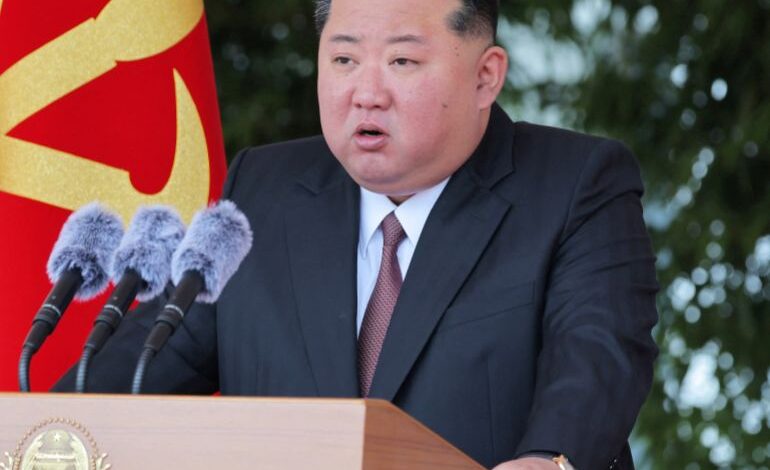
North Korean leader Kim Jong Un has renewed calls for a significant expansion of the country’s military capabilities, emphasizing the need to strengthen its nuclear deterrent amid what he described as growing security threats in the region.
Speaking during a high-level defense meeting in Pyongyang in early June 2026, Kim reportedly instructed military and defense officials to accelerate the development of strategic weapons systems and enhance the country’s overall defense readiness.
According to state media reports, the North Korean leader stressed that the international security environment has become increasingly unstable, requiring the country to bolster its military strength and maintain what he called a powerful deterrence capability.
Kim argued that North Korea must continue investing in advanced military technology, including long-range missile systems and strategic defense assets, to protect its sovereignty and national interests.
The remarks come amid ongoing tensions on the Korean Peninsula, where military exercises involving the United States and South Korea have continued to draw criticism from Pyongyang. North Korean officials have frequently described such exercises as provocative and have cited them as justification for expanding the country’s weapons programs.
Observers say Kim’s latest comments signal that the country is unlikely to slow down its military modernization efforts despite repeated international calls for denuclearization. Analysts believe North Korea’s leadership views its nuclear arsenal as a key pillar of national security and a crucial bargaining tool in diplomatic negotiations.
Over the past several years, North Korea has conducted numerous missile tests and unveiled various weapons systems designed to demonstrate its military capabilities. These developments have attracted concern from neighboring countries and the wider international community.
Governments including the United States, Japan, and South Korea have repeatedly urged North Korea to return to diplomatic talks aimed at reducing tensions and addressing concerns over its weapons programs. However, efforts to revive meaningful negotiations have faced significant obstacles.
Security experts note that the continued expansion of North Korea’s strategic weapons capabilities could further complicate regional security dynamics and increase concerns about an arms race in East Asia.
Meanwhile, officials in Seoul and Washington are closely monitoring developments, with both governments reaffirming their commitment to maintaining regional stability and strengthening defense cooperation.
International organizations and foreign policy analysts have also emphasized the importance of diplomatic engagement, warning that escalating military competition could heighten tensions and increase the risk of misunderstandings between regional powers.
Despite global concerns, North Korean authorities maintain that their defense programs are necessary for national protection and deterrence. State media continue to portray military development as a response to external threats and international pressure.
As geopolitical tensions remain high, many observers believe the future of security in the region will depend on whether diplomatic channels can be reopened and confidence-building measures pursued by all parties involved.
For now, Kim Jong Un’s latest directive underscores North Korea’s determination to continue strengthening its strategic military capabilities, a move that is expected to remain a major focus of international attention in the months ahead.
Kim Jong Un’s latest remarks have triggered renewed discussions among international leaders and security experts about the future of stability in East Asia.
Officials in South Korea described the development as a matter requiring close monitoring, reiterating their commitment to maintaining national security while keeping diplomatic channels open whenever possible. South Korea’s Ministry of National Defense stated that it would continue working closely with allies to assess any changes in North Korea’s military posture.
In Japan, government officials expressed concern over the possibility of further missile tests and weapons development. Japanese authorities have repeatedly emphasized the need for stronger regional cooperation to address security challenges posed by North Korea’s expanding military capabilities.
The United States also reaffirmed its commitment to defending its allies in the region. Senior American officials stressed that Washington remains focused on deterrence, diplomacy, and maintaining peace and stability across the Korean Peninsula.
Meanwhile, the United Nations and several international organizations have continued to call for dialogue and restraint. Diplomats argue that meaningful negotiations remain the most effective path toward reducing tensions and preventing further escalation.
Despite facing economic difficulties, North Korea has continued to prioritize defense spending and military modernization.
Analysts note that the country’s leadership has consistently presented military strength as essential to national survival. State media frequently portrays advancements in defense technology as symbols of national pride and sovereignty.
Critics, however, argue that greater investment in economic development, food security, healthcare, and infrastructure could help address many of the challenges facing ordinary North Korean citizens.
The government has maintained that strengthening defense capabilities and improving economic conditions are objectives that can be pursued simultaneously.
Security experts believe the coming months could prove significant for regional stability. Many are watching closely for signs of additional missile tests, military demonstrations, or diplomatic initiatives that could shape future relations between North Korea and neighboring countries.
The international community continues to face the challenge of balancing deterrence with diplomacy while seeking ways to reduce tensions and encourage constructive engagement.
Su
Kim Jong Un has called for a substantial expansion of North Korea’s strategic military capabilities, arguing that the country’s security environment requires stronger deterrence measures. His comments come amid ongoing regional tensions and continued international concern over North Korea’s weapons programs.
The announcement has drawn reactions from South Korea, Japan, the United States, and global organizations, all of which have emphasized the importance of stability and dialogue.
While North Korea views military development as essential to national security, many observers believe diplomatic engagement will remain critical in determining the future of peace and security on the Korean Peninsula and across the wider region.n