

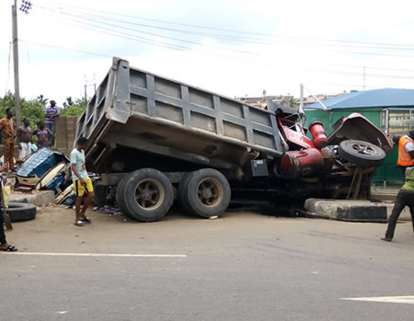
A man has been killed after he was reportedly crushed by a truck along the Lagos-Ibadan Expressway, in a tragic road accident that has renewed concerns about the safety of motorists and other road users on the busy highway.
The incident occurred along the major expressway, one of the most heavily travelled routes in southwestern Nigeria. The victim, whose identity was not immediately known, reportedly died after coming into contact with the moving truck.
Details surrounding the circumstances of the crash remain limited, but the fatal incident has already caused concern among road users and residents in the area.
The Lagos-Ibadan Expressway serves as a major link between Lagos and several other parts of the South-West and carries thousands of vehicles daily. Commercial buses, private cars, articulated trucks and other heavy-duty vehicles regularly use the route, making road safety a major concern.
Accidents involving articulated trucks can be particularly devastating because of their size, weight and limited stopping distance. When a truck collides with a pedestrian or smaller vehicle, the consequences can be severe.
The latest tragedy has once again highlighted the importance of caution among all categories of road users.
For truck drivers, maintaining appropriate speed and keeping a safe distance from other vehicles are essential, particularly on busy sections of the highway. Heavy vehicles require more time and distance to stop, especially when they are carrying significant loads.
The condition of the truck could also become relevant as authorities seek to establish what caused the accident.
Mechanical problems, brake failure, tyre issues, poor visibility and driver fatigue are among the factors that can contribute to serious road crashes involving heavy-duty vehicles.
The behaviour of other road users may also be examined as part of efforts to determine exactly how the collision occurred.
The position of the victim, the direction in which the truck was travelling and the events immediately before the crash could help investigators establish the circumstances surrounding the man’s death.
The tragedy is also likely to raise concerns about pedestrian safety along the expressway.
Although the Lagos-Ibadan Expressway is primarily designed for vehicular movement, people sometimes find themselves walking close to the highway or attempting to cross it because of settlements, businesses, transport stops and other activities located around different sections of the road.
Such situations can expose pedestrians to serious danger, particularly when heavy vehicles are approaching.
The risk becomes even greater at busy periods when traffic volumes increase and drivers have less time to respond to unexpected movements.
The death of the unidentified man is therefore another reminder of the need for stronger road safety awareness.
Authorities and road safety officials may need to intensify enforcement and public education along dangerous sections of the highway.
Drivers should be encouraged to obey speed limits, avoid reckless overtaking and remain alert at all times.
Truck operators in particular need to ensure that their vehicles are properly maintained before embarking on long journeys.
A mechanical defect that might appear minor can become fatal when it occurs on a busy highway.
The responsibility, however, does not rest solely with truck drivers.
Pedestrians and other road users must also exercise extreme caution around heavy-duty vehicles.
People should avoid standing unnecessarily close to moving trucks, should use designated pedestrian crossings where available and should never assume that a truck driver has seen them.
Large vehicles also have significant blind spots, meaning drivers may not always be able to see pedestrians or smaller vehicles positioned close to them.
The latest crash has also brought renewed attention to the broader problem of road accidents in Nigeria.
Fatal crashes continue to claim lives across the country, affecting families and communities and creating additional economic and social difficulties.
A single road accident can leave families without a breadwinner and impose unexpected financial burdens on relatives.
When the identity of a victim is not immediately known, the situation can become even more painful because family members may be unaware that their relative has been involved in an accident.
Authorities will therefore need to establish the identity of the deceased and ensure that his family is informed.
The appropriate authorities may also be expected to secure the accident scene, document what happened and determine whether any offence or traffic violation occurred.
If the investigation establishes negligence or a breach of road safety regulations, appropriate action may follow.
Beyond the immediate investigation, the incident presents an opportunity to examine safety conditions along the Lagos-Ibadan Expressway.
The highway remains vital to the movement of people and goods between Lagos and other parts of the country.
Thousands of traders, workers, travellers and businesses depend on the route every day.
Keeping it safe is therefore essential not only for saving lives but also for protecting economic activities.
The latest fatality is a painful reminder that road safety must remain a continuous priority.
Infrastructure improvements can help, but they must be supported by responsible driving, proper vehicle maintenance, effective enforcement and better pedestrian awareness.
Emergency response is another important aspect of highway safety.
When accidents occur, rapid response can help prevent additional casualties and provide immediate assistance to injured persons.
Clear emergency channels and strategically positioned response teams can improve the chances of saving lives following serious crashes.
In the case of the latest incident, the focus remains on establishing exactly what happened and ensuring that the victim is properly identified.
The circumstances of the crash should also be investigated thoroughly so that any lessons that could prevent similar incidents can be identified.
For motorists using the Lagos-Ibadan Expressway, the incident serves as another warning to remain vigilant.
Drivers are encouraged to reduce their speed in busy areas, maintain safe distances and avoid distractions while behind the wheel.
Truck drivers, given the weight and size of their vehicles, have an especially important responsibility to exercise caution.
The loss of another life on one of Nigeria’s busiest highways has once again demonstrated the devastating consequences that can result when road safety is compromised.
For the family of the deceased, the incident represents an enormous and sudden loss.
For other road users, it should serve as a reminder that caution cannot be taken for granted.
As authorities continue to look into the circumstances surrounding the crash, there will be growing expectations for stronger measures to reduce fatal accidents along the Lagos-Ibadan Expressway.
The ultimate goal should be to ensure that people can travel along the major route safely without having to fear that an ordinary journey could end in tragedy.