
Iran Begins Multi-Day Funeral for Supreme Leader Ayatollah Ali Khamenei Following Wartime Death

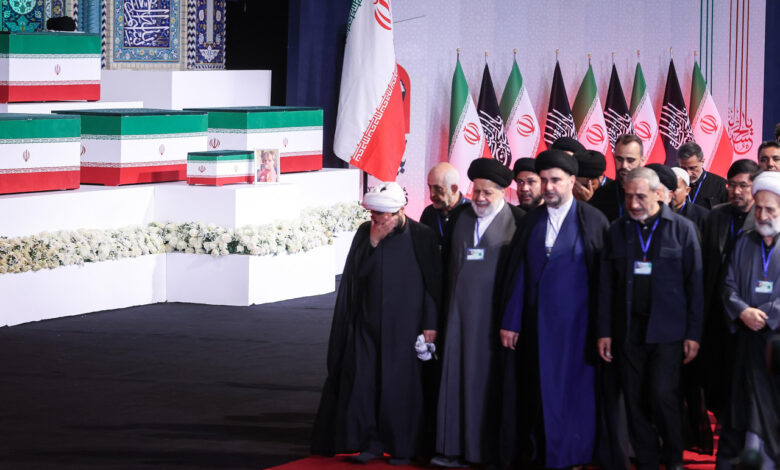
Foreign and domestic officials pay respects before the coffins of late Iranian Supreme Leader Ayatollah Ali Khamenei and members of his family, at Imam Khomeini Grand Mosque in Tehran, Iran, Friday
Iran has entered a historic period of national mourning as the country commenced an elaborate multi-day funeral ceremony for its late Supreme Leader, Ayatollah Ali Khamenei, whose death during the recent conflict has marked one of the most significant turning points in the nation’s modern political history.
The solemn ceremonies began in Tehran, where massive crowds gathered from the early hours of the day to pay their final respects to the man who served as Iran’s highest political and religious authority for nearly four decades. Streets surrounding major religious and government landmarks were filled with mourners dressed in black, many carrying portraits of the late leader, Iranian flags, and religious banners as prayers echoed across the capital.
Authorities described the funeral as both a farewell to one of the Islamic Republic’s most influential figures and a symbol of national unity during a period of uncertainty following months of military confrontation that reshaped the country’s political landscape.
Government officials declared several days of national mourning, with memorial events, religious gatherings, and commemorative processions scheduled to take place across different provinces. State institutions, educational establishments, and numerous public offices observed special ceremonies in honour of the late Supreme Leader, while state media provided continuous coverage of the funeral proceedings.
The death of Ayatollah Ali Khamenei came during the recent war that significantly escalated tensions across the Middle East, bringing an end to a leadership that had profoundly influenced Iran’s domestic governance, regional strategy, and international relations since 1989.
Throughout his decades in office, Khamenei remained the country’s highest decision-maker, exercising authority over Iran’s armed forces, judiciary, major state institutions, and foreign policy. His leadership witnessed periods of economic sanctions, diplomatic negotiations, regional conflicts, and significant technological and military developments that shaped the direction of the Islamic Republic.
For many Iranians, the funeral represents the conclusion of an era defined by Khamenei’s political ideology and religious leadership. Generations of citizens knew no other Supreme Leader, making his passing one of the most consequential events in the country’s contemporary history.
Security across Tehran and other major cities was significantly strengthened as authorities prepared for the arrival of large numbers of mourners. Security personnel were deployed throughout the capital, traffic restrictions were introduced around major ceremonial venues, and emergency response teams remained on standby to manage the enormous crowds expected to participate in the funeral activities.
Officials estimated that millions of people from across Iran, along with visitors from neighbouring countries, would participate in different stages of the ceremonies over the coming days.
The funeral programme includes religious prayers, public processions, official state ceremonies, and commemorative gatherings led by senior clerics and government officials. Religious leaders have described the occasion as an opportunity for the nation to reflect on Khamenei’s decades of service while reaffirming the values upon which the Islamic Republic was founded.
Messages of condolence have continued to arrive from political leaders, religious institutions, and governments across various parts of the world. Several countries expressed sympathy to the Iranian people while acknowledging Khamenei’s long-standing influence on regional and international affairs.
Political observers note that the funeral extends beyond its religious significance and carries substantial political importance. They argue that such ceremonies provide an opportunity for Iran’s leadership to demonstrate institutional stability and reassure both domestic and international audiences that the country’s governing structures remain intact despite the loss of its most powerful figure.
The transition to new leadership has become one of the central issues dominating discussions both inside and outside Iran. Analysts believe the period following the funeral will be closely watched as the country’s political establishment navigates one of the most significant leadership transitions since the death of Ayatollah Ruhollah Khomeini in 1989.
Attention has also focused on the future direction of Iran’s foreign policy, regional alliances, economic strategy, and security doctrine. Experts suggest that while major state institutions are expected to maintain continuity, the emergence of new leadership may gradually shape policy priorities in response to evolving domestic and international challenges.
Within Iran, many citizens used the funeral as an opportunity to remember the late Supreme Leader’s lengthy public service. Supporters credited him with guiding the country through periods of external pressure, economic sanctions, and regional instability while maintaining what they described as the independence of the Islamic Republic.
Others reflected on the immense influence he exercised over nearly every aspect of Iranian public life, from religious affairs and national security to constitutional oversight and strategic policymaking.
Meanwhile, international analysts believe the coming months will prove critical in determining how Iran adapts to a rapidly changing geopolitical environment following both the recent conflict and the transition in national leadership.
Diplomatic observers expect global attention to remain firmly fixed on Tehran as government institutions continue implementing constitutional procedures associated with succession while seeking to preserve political stability during a sensitive period.
The ongoing funeral ceremonies are therefore viewed not only as a national farewell but also as a defining historical moment that will shape how future generations remember one of the most influential leaders in the history of the Islamic Republic.
As processions continue across several cities, millions of Iranians are expected to participate in prayers and memorial services before the funeral concludes with the final burial ceremonies. The atmosphere throughout the country remains one of reflection, remembrance, and national mourning as citizens honour the memory of a leader whose decisions influenced Iran’s political, religious, and strategic direction for almost four decades.
Although the nation now enters a new chapter without the figure who dominated its leadership for so many years, the legacy of Ayatollah Ali Khamenei is expected to remain central to discussions about Iran’s past, present, and future. The days ahead are likely to be remembered as one of the most significant moments in the country’s contemporary history, marking both the end of a remarkable political era and the beginning of a new phase for the Islamic Republic.