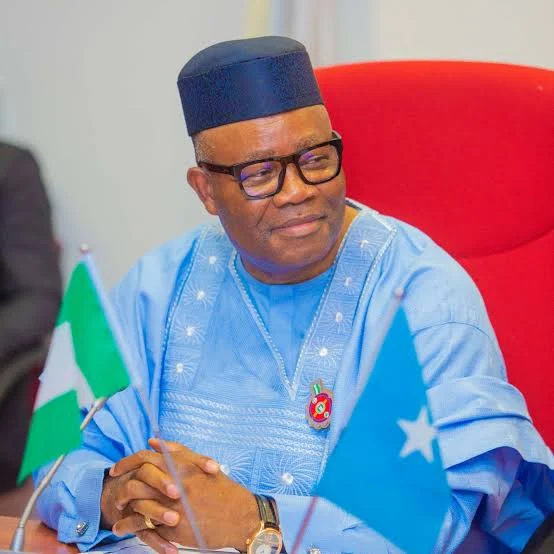
Akwa Ibom Government Sparks Controversy Over Akpabio’s ‘Acting President’ Description

The Akwa Ibom State Government has triggered fresh political discussion after referring to Senate President Godswill Akpabio as an “Acting President” during an official communication.
The description has attracted attention because Nigeria’s Constitution provides specific procedures for determining who performs the functions of the President when the President is unavailable.
Akpabio, a former governor of Akwa Ibom State, currently serves as President of the Nigerian Senate, making him the country’s third-highest political office holder under the constitutional order.
The reference to him as “Acting President” has therefore generated questions over whether the wording was deliberate, ceremonial or simply an error in an official government communication.
Akpabio has remained one of the most influential political figures from Akwa Ibom and has played a prominent role in national politics since leaving the governorship.
He served as governor of Akwa Ibom between 2007 and 2015, after which he moved into federal politics and later became Senate President.
His political journey has made him a major figure within the ruling political establishment.
The latest controversy comes at a time when political activities are gradually intensifying ahead of the 2027 general election.

The relationship between Akwa Ibom and the federal political leadership has also remained an important subject of public discussion because of Akpabio’s position at the National Assembly.
As Senate President, Akpabio presides over the upper chamber of the National Assembly and plays a major role in legislative proceedings.
However, the office of Senate President does not automatically confer presidential powers.
Under Nigeria’s constitutional framework, the Vice President is the person who assumes the functions of the President when the President is unable to perform those functions, subject to the circumstances and procedures established by the Constitution.
This makes the use of the phrase “Acting President” in reference to Akpabio particularly sensitive.
The wording could create confusion among members of the public who are unfamiliar with the constitutional distinction between the Senate President and the Acting President.
The development has consequently generated political conversations, particularly on social media, where Nigerians have questioned the circumstances behind the description.
Some have interpreted the reference as an indication of the strong political influence Akpabio currently enjoys.
Others have suggested that the wording may simply have been an administrative or communication error.
Akpabio’s political importance in Akwa Ibom is not in doubt.
He remains one of the state’s most prominent political figures and has maintained a strong presence in national affairs since becoming Senate President.
His tenure in the Senate leadership has also coincided with significant political developments at the federal level.
The Senate under his leadership has considered several major bills and government policies, including legislation relating to taxation, economic reforms, security and public administration.
The Senate President has frequently defended the legislative agenda of the Tinubu administration and emphasised cooperation between the executive and legislative arms of government.
His political alignment with President Bola Ahmed Tinubu has also made him a key figure within the ruling political structure.
The reference from the Akwa Ibom government is therefore likely to attract attention beyond the state.
It comes at a period when political alliances are being closely monitored ahead of the next presidential election.
The 2027 election is expected to produce intense competition among political parties, with the APC preparing to defend its position at the federal level and opposition groups working to build a stronger challenge.
Akpabio’s position as Senate President gives him considerable influence within the ruling party and the National Assembly.
However, constitutional titles carry specific meanings, particularly when they concern the highest office in the country.
The President remains the holder of executive authority at the federal level, while the Vice President is constitutionally positioned to perform presidential functions in circumstances where the President is unable to do so.
The Senate President has a separate constitutional responsibility as head of the upper legislative chamber.
The controversy has therefore highlighted the importance of accuracy in official government communications.
Even a seemingly simple description can generate questions when it concerns senior political offices.
The Akwa Ibom government may face pressure to clarify the circumstances surrounding the reference and whether the term was intended to carry any constitutional meaning.
The development has also revived discussions about Akpabio’s political influence and his growing prominence in national affairs.
From his time as governor of Akwa Ibom to his current position as Senate President, Akpabio has remained a major player in Nigerian politics.
His political career has included leadership positions at both state and federal levels, giving him significant experience in governance and party politics.
The latest incident is therefore unlikely to end the public interest surrounding his role.
For now, the phrase “Acting President” remains the central point of the controversy, with Nigerians examining whether it was simply an unfortunate choice of words or something that requires further explanation.
As political activities ahead of 2027 continue to gather momentum, statements involving senior political figures are likely to receive increasing scrutiny.
The episode has once again demonstrated how closely Nigerians watch the language used by government institutions, particularly when it relates to constitutional offices and the country’s political leadership.