
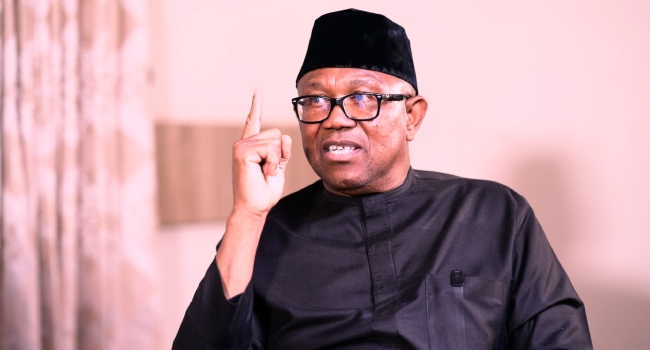
Presidential candidate of the Nigeria Democratic Congress, Peter Obi, has promised to make changes to Nigeria’s military leadership within the first week of assuming office if elected president in the 2027 general election.
Obi said one of his immediate priorities would be the appointment of new service chiefs, arguing that the country’s security challenges require a leadership structure capable of responding decisively to threats confronting Nigerians.
The former Anambra State governor made the pledge while outlining his plans for national security and governance ahead of the 2027 presidential contest.
He said his proposed administration would treat insecurity as an emergency requiring urgent and coordinated action, rather than an issue that could be addressed through isolated measures.
According to Obi’s campaign position, the security of lives and property would be placed among the highest priorities of his administration.
He argued that the effectiveness of the armed forces depends not only on the number of personnel and weapons available but also on the quality of leadership, coordination and strategic direction provided at the highest levels.
Obi therefore indicated that a review of the military command structure would be among the first decisions he would take after assuming the presidency.
The proposed appointment of new service chiefs would affect the leadership of Nigeria’s armed forces, including the army, navy and air force.
Obi has maintained that the country needs a security leadership capable of confronting terrorism, banditry, kidnapping, insurgency and other forms of violent crime that have affected communities across different parts of the country.
He has also repeatedly linked insecurity to economic hardship, arguing that a nation cannot achieve meaningful development when citizens are unable to live, travel or conduct businesses safely.
Under his proposed administration, security agencies would be expected to operate with clearer objectives and stronger accountability.
Obi has argued that the government must know exactly what it is spending on security and what results are being achieved from such expenditure.
He has also called for greater investment in intelligence gathering, modern equipment, technology and the welfare of security personnel.
The former Anambra governor has criticised the continued loss of lives to attacks by armed groups and has argued that government must move beyond reacting to incidents after they occur.
He has advocated stronger intelligence-led operations capable of identifying threats before they develop into major attacks.
His proposed security strategy would also involve closer coordination among the military, police and other security agencies.
Obi believes that overlapping responsibilities and poor coordination can weaken the government’s response to criminal and insurgent groups.
He has therefore called for a system in which security agencies share intelligence more effectively and operate within clearly defined responsibilities.
The service chiefs would consequently be expected to work under a broader national security strategy established by the president and his security team.
Obi’s promise to make the appointments within his first week in office also reflects his argument that a new administration should begin implementing its agenda immediately rather than spending its early months establishing direction.
He has said that the first days of a government should be used to communicate clear priorities and begin acting on the most urgent problems facing the country.
Security would be among those immediate priorities.
Nigeria has continued to face multiple security threats, although the nature and intensity of violence vary from one region to another.
The North-East continues to deal with the legacy of Boko Haram and Islamic State West Africa Province insurgency, while parts of the North-West have experienced persistent attacks by armed bandit groups and kidnappers.
In the North-Central region, communities have also faced deadly attacks and disputes involving armed groups, while kidnapping and other forms of criminality remain concerns in several parts of the country.
The South-East has also experienced security challenges involving attacks on security personnel, public facilities and communities.
Obi has argued that the federal government must develop a comprehensive approach capable of addressing the different causes and forms of insecurity rather than applying one solution nationwide.
He has also stressed the importance of strengthening the economy as part of the fight against crime.
According to his political argument, creating jobs and improving living conditions would reduce the number of young people vulnerable to recruitment by criminal groups.
He has repeatedly placed human capital development, education, healthcare and economic opportunity alongside security in his policy discussions.
For Obi, security and development are interconnected.
A farmer who cannot safely reach his farm cannot produce enough food. A business owner operating in an insecure environment faces higher costs. Children living in communities affected by violence may also struggle to attend school.
The presidential hopeful has therefore presented security as a foundation for achieving economic growth and improving living standards.
His proposed changes to the military leadership would be accompanied by broader reforms within the security sector.
Obi has called for improved welfare for soldiers and other security personnel, arguing that personnel tasked with protecting citizens should have adequate equipment, training, accommodation and other necessary support.
He has also spoken about the need to ensure that public funds allocated to security are properly utilised.
The former governor has argued that corruption and waste within government can undermine national security by diverting resources meant for essential operations.
He has promised to pursue greater transparency in public spending and strengthen accountability mechanisms.
The proposed approach would also involve strengthening domestic production of military and security equipment where possible.
Obi has argued that Nigeria should gradually reduce its dependence on imported equipment by developing local industrial capacity capable of supporting the security sector.
Such a strategy, he believes, could create jobs while improving the country’s ability to maintain and upgrade essential equipment.
He has also emphasised the importance of technology in modern security operations.
Surveillance systems, intelligence databases, communication technology and other modern tools could improve the ability of security agencies to monitor threats and respond quickly.
Obi’s comments come as political parties prepare for what is expected to be a highly competitive 2027 presidential election.
The former Anambra governor is seeking to return to the presidential contest after his strong performance in the 2023 election, when he contested on the Labour Party platform.
He has since joined the Nigeria Democratic Congress and emerged as its presidential candidate for the 2027 election.
His campaign has been built around promises of economic reform, reduction in the cost of governance, improved security and greater accountability.
The pledge concerning service chiefs is therefore part of a wider argument that his administration would move quickly to address Nigeria’s most pressing challenges.
However, the appointment of service chiefs is constitutionally a presidential responsibility and would have to be carried out within the relevant legal and institutional framework.
The effectiveness of any new military leadership would also depend on factors beyond appointments, including funding, intelligence, equipment, personnel, inter-agency cooperation and the broader national security strategy.
Changing service chiefs alone would not automatically resolve Nigeria’s security problems.
The success of such a policy would ultimately depend on whether the new leadership could translate presidential directives into effective operations and whether the government could provide the resources required to implement its strategy.
Obi’s promise nevertheless signals his intention to make security one of the first areas of government attention if he wins the presidency.
He has maintained that Nigerians should not have to live in fear of terrorists, kidnappers, bandits or other armed groups.
He has also argued that government must be judged by its ability to protect citizens and provide an environment in which people can work, invest and raise their families safely.
As the 2027 campaign gathers momentum, security is expected to remain one of the biggest issues confronting presidential candidates.
Voters are likely to assess the competing candidates on their proposed approaches to terrorism, kidnapping, banditry, communal violence and the protection of vulnerable communities.
They will also be watching for details about how each candidate intends to finance security reforms and measure their effectiveness.
For Obi, the immediate appointment of new service chiefs would be one of the first signals that his administration intends to take a different approach to national security.
He has presented the first week of his presidency as a period for decisive action, with the military leadership among the areas he would seek to reorganise.
Whether the promise will translate into improved security would ultimately depend on the policies that follow the appointments and the ability of the administration to implement them effectively.
For now, the pledge has added another major security proposal to the growing list of commitments being presented to Nigerians ahead of the 2027 presidential election.