
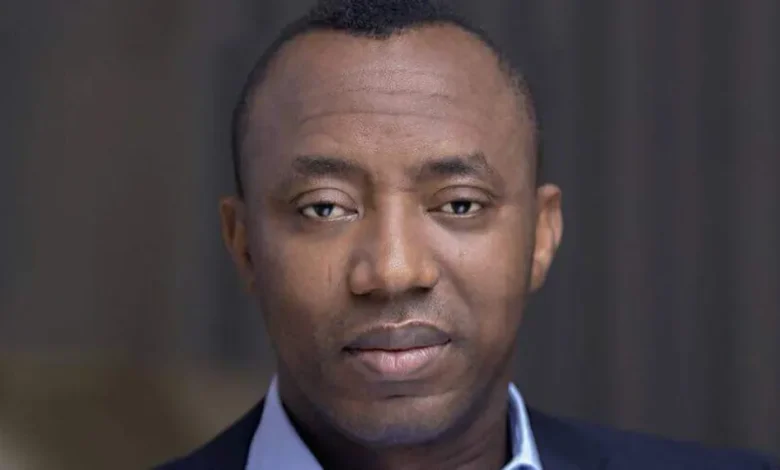
Presidential candidate of the African Action Congress, Omoyele Sowore, has declared that he would not travel outside Nigeria to seek medical treatment if elected president in 2027, saying he would rather accept the consequences if a medical condition could not be treated within the country.
Sowore made the statement during an appearance on Channels Television’s Politics Today, where he discussed his plans for the presidency and his position on the use of public resources by political leaders.
The AAC candidate was asked about the practice of Nigerian political leaders travelling abroad for medical care, a long-standing issue that has generated criticism because of concerns over the state of the country’s healthcare system.
In response, Sowore said he opposed the practice and insisted that he would not make use of foreign medical facilities while serving as president.
He made the striking declaration that any illness he could not have treated in Nigeria as president should be allowed to take its course rather than prompting him to seek treatment abroad.
His position was presented as part of his broader argument that Nigerian leaders should have confidence in and make use of the country’s own institutions instead of relying on foreign facilities.
The issue of medical tourism has remained a major subject of public debate in Nigeria, particularly whenever senior government officials travel abroad for medical care.
Critics of the practice argue that political leaders who depend on foreign hospitals undermine confidence in Nigeria’s healthcare system and have little incentive to address the problems affecting hospitals and medical services at home.
Sowore’s position appears to be linked to that wider argument.
He has repeatedly campaigned on the need to reduce what he considers unnecessary privileges associated with political office and to redirect public resources towards essential services.
During the same television appearance, the AAC candidate also spoke about his position on the Office of the First Lady.
He said that if elected president, he would not establish an official Office of the First Lady, arguing that the position is not created by the Nigerian Constitution.
Sowore stressed that becoming president would not mean ending his marriage, but said his wife would not occupy an official government position simply because he became president.
He maintained that women would still have important roles in his administration and that female Nigerians would be able to serve in constitutionally recognised government positions.
His objection, he explained, was specifically to maintaining an official structure around the president’s spouse that he believes lacks a constitutional foundation.
The two positions form part of Sowore’s wider campaign message ahead of the 2027 presidential election.
He has sought to distinguish his proposed administration from what he describes as established political practices that allow public officials and their families to benefit from government resources.
Sowore also addressed the issue of his children during the interview, saying they were born in Nigeria and would likely have completed their education by the time he assumes office, if he wins the election.
He said he would not bring his children into the country to benefit from presidential resources or government privileges.
According to his position, his family would remain separate from the responsibilities and resources of the Nigerian state.
The comments reflect one of the central themes of his political campaign: reducing the use of public office for personal or family benefits.
Sowore has previously advocated significant changes to Nigeria’s political and economic system and has presented himself as a candidate willing to challenge established practices.
His latest comments on healthcare therefore go beyond the question of where a president receives medical attention.
They also raise questions about the state of Nigeria’s healthcare infrastructure and whether political leaders should personally rely on the same healthcare system available to ordinary citizens.
Nigeria has a large network of public and private hospitals, medical professionals and specialist facilities, but the health sector continues to face challenges involving infrastructure, equipment, funding, staffing and access to specialised treatment.
Some complex medical conditions may require highly specialised equipment or expertise that is not readily available in every part of the country.
The debate over medical tourism has consequently included calls for increased investment in specialist hospitals, medical research, equipment and the retention of highly trained healthcare professionals.
Supporters of domestic healthcare argue that improving Nigerian hospitals would not only reduce the need for citizens to travel abroad but could also create jobs and strengthen the country’s medical sector.
Others point out that patients, including public officials, should be able to seek whatever treatment is medically appropriate regardless of where it is available.
Sowore’s proposed approach takes a different position, with his personal commitment intended to demonstrate confidence in domestic healthcare and pressure future governments to improve the system.
His declaration also places greater attention on the responsibilities that come with presidential office.
The president has access to considerable public resources and represents the Nigerian state both domestically and internationally. Decisions made by the occupant of the office can therefore influence public perceptions of government institutions.
Sowore appears to be arguing that a president who depends on Nigerian institutions would have a stronger personal incentive to ensure that those institutions work effectively.
The same principle underlies his criticism of the Office of the First Lady, which he views as an example of presidential structures that can operate outside clearly defined constitutional offices.
He said public resources should instead be directed towards development projects and services that benefit Nigerians.
The comments are likely to generate debate because both medical treatment abroad and the activities of presidential spouses have become familiar features of Nigerian public life.
Presidential and senior government officials have historically travelled abroad for medical treatment, while the wives of presidents have often maintained offices and launched programmes focused on issues such as healthcare, education, women empowerment and social welfare.
Sowore’s proposed approach would represent a significant departure from those practices if implemented.
However, the practical implications of his healthcare position would depend on the condition of Nigeria’s medical facilities at the time and the availability of appropriate specialist treatment.
A president could face medical circumstances requiring highly specialised care, and the question of whether such treatment could be provided domestically would depend on the capacity of Nigerian hospitals and medical professionals.
For now, Sowore’s statement remains a campaign commitment.
He is expected to continue presenting his policy proposals as political parties and candidates prepare for the 2027 general elections.
The AAC candidate has built much of his campaign around reducing corruption, cutting waste, challenging political privilege and improving public institutions.
His latest comments fit into that broader message by arguing that political leaders should not use public office as a route to special treatment for themselves or their families.
Whether voters agree with that approach will form part of the broader political debate ahead of the election.
The discussion around medical tourism is also likely to remain relevant because healthcare affects virtually every Nigerian household.
Beyond the question of where politicians receive treatment, the larger challenge is how to build a healthcare system capable of providing quality services to citizens regardless of their financial status.
Sowore’s declaration has therefore renewed attention on the relationship between political leadership and public institutions.
If elected, he says he would rely on Nigeria’s healthcare system rather than travelling abroad for treatment and would keep his family outside the formal structures of presidential administration.
For now, these remain campaign positions that would require implementation through government policy if he were elected.
The remarks have nevertheless added healthcare, presidential privileges and the role of political families to the growing list of issues that Nigerian voters are likely to consider as the country moves towards the 2027 presidential election.