
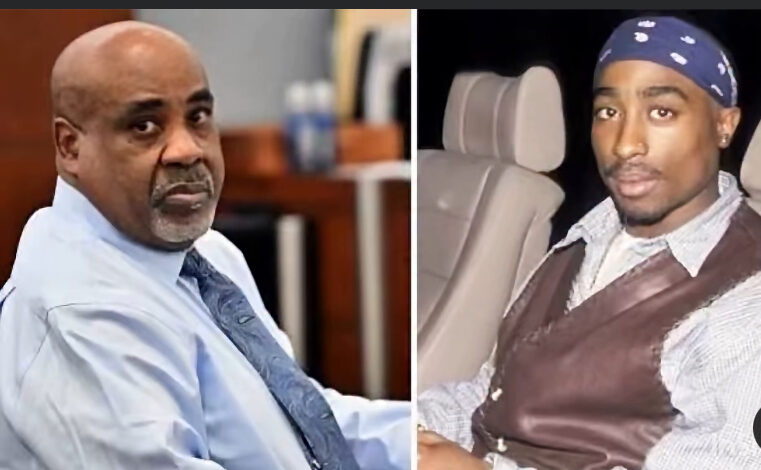
A Las Vegas jury has found Duane “Keffe D” Davis guilty of first-degree murder in connection with the 1996 killing of legendary rapper Tupac Shakur, nearly three decades after the hip-hop icon was fatally shot in Las Vegas.
The verdict was delivered on September 1, 2026, marking a major turning point in a case that remained unsolved for almost 30 years and became one of the most famous murder mysteries in music history.
Davis, 63, was convicted of first-degree murder with the use of a deadly weapon. The conviction makes him the first person to be found criminally responsible in court for Shakur’s death.
The case dates back to the night of September 7, 1996, when Tupac was travelling through Las Vegas following a major boxing event.
The rapper had attended the highly anticipated Mike Tyson versus Bruce Seldon fight at the MGM Grand Garden Arena alongside members of his entourage.
After the fight, Shakur and Death Row Records boss Marion “Suge” Knight left the venue in a black BMW.
The vehicle was travelling along Las Vegas Boulevard when a white Cadillac pulled alongside it.
Gunfire suddenly erupted from the Cadillac.
Several bullets struck Shakur, while Knight was also wounded.
The attack shocked the entertainment world.
Shakur was rushed to University Medical Center of Southern Nevada, where doctors attempted to save his life.
Despite intensive medical treatment, his condition continued to deteriorate.
On September 13, 1996, six days after the shooting, Tupac died from his injuries.
He was only 25 years old.
His death immediately generated worldwide mourning and triggered years of speculation about who was responsible.
Investigators faced enormous difficulties in establishing what happened that night.
The shooting occurred in a crowded city, but the identities of the people inside the Cadillac and the person who fired the weapon remained disputed for years.
The absence of a prosecution allowed numerous theories about the killing to spread.
The case eventually began receiving renewed attention after Davis repeatedly discussed his knowledge of the shooting.
Davis, who was associated with the South Side Compton Crips, had previously spoken publicly about his connection to events surrounding Shakur’s death.
His public statements eventually became important to investigators.
Authorities reopened significant aspects of the investigation and searched for evidence that could connect Davis to the attack.
In July 2023, police carried out a search of a property connected to Davis in Henderson, Nevada, as part of the renewed investigation.
A few months later, Davis was arrested and charged with murder.
The arrest represented the first major breakthrough in the case since Shakur’s death.
Prosecutors argued that Davis played a central role in organising the attack.
They maintained that the confrontation between Shakur’s group and Orlando “Baby Lane” Anderson earlier that evening provided the motive for the shooting.
Anderson was Davis’ nephew and was associated with the South Side Compton Crips.
Earlier on the same night, Shakur and members of his entourage encountered Anderson inside the MGM Grand.
A physical confrontation followed.
The incident became a critical part of the prosecution’s explanation for what happened later that night.
According to the prosecution’s case, the confrontation created a desire for retaliation against Shakur and those accompanying him.
Davis was accused of helping arrange the attack and obtaining the firearm used in the shooting.
However, prosecutors did not claim that Davis personally fired the fatal shots.
Instead, they argued that his role in planning and facilitating the attack made him responsible for the murder under Nevada law.
The person believed to have fired the shots has long been identified by investigators as Anderson.
Anderson was never prosecuted for Shakur’s murder and died in 1998, only about two years after the rapper’s death.
His death meant that investigators could no longer question him directly or bring him before a court.
Other individuals believed to have had knowledge of the shooting also died over the years.
This left Davis as the only person directly prosecuted in connection with the killing.
During the trial, prosecutors relied heavily on Davis’ own statements about the events.
They presented evidence intended to show that his accounts connected him to the planning of the shooting.
The defence challenged those statements and questioned whether Davis’ recollections were reliable after so many years.
His legal team argued that Davis had made different statements over time and suggested that some of his public comments could have been exaggerated.
The defence also challenged the prosecution’s interpretation of evidence surrounding Davis’ location and activities on the night Shakur was killed.
Despite the defence arguments, the jury ultimately accepted the prosecution’s case and found Davis guilty.
The verdict brings the first courtroom conviction in a murder that has remained deeply connected to the history of hip-hop.
Tupac Shakur’s influence extended far beyond music.
He became a cultural figure whose songs addressed poverty, racism, violence, family struggles, social inequality and life in disadvantaged communities.
His career produced several critically acclaimed and commercially successful albums.
Among his best-known works are “Me Against the World,” “All Eyez on Me” and “The Don Killuminati: The 7 Day Theory.”
Songs such as “Dear Mama,” “California Love,” “Changes,” “Keep Ya Head Up” and “Hail Mary” helped establish his lasting legacy.
His death also became closely associated with the turbulent period of the 1990s hip-hop rivalry.
At the time, tensions between major figures on the American East Coast and West Coast rap scenes had reached dangerous levels.
Tupac was closely linked to the West Coast movement and Death Row Records.
His public rivalry with artists associated with New York-based Bad Boy Records contributed to the intense atmosphere surrounding the music industry.
The murder of Tupac was followed months later by another devastating loss.
Christopher Wallace, better known as The Notorious B.I.G., was killed in Los Angeles in March 1997.
The two deaths intensified fears about violence within the hip-hop community and turned both cases into enduring mysteries.
While Davis’ conviction provides a legal conclusion regarding his role in Shakur’s killing, it does not resolve every question surrounding the murder.
The identity of the person who actually fired the fatal shots remains a major part of the historical mystery.
The conviction instead establishes Davis’ criminal responsibility based on the prosecution’s theory that he participated in organising the attack.
The case has also demonstrated how difficult it can be to investigate a high-profile murder decades after it occurred.
Witnesses can die, evidence can disappear and memories can become less reliable with time.
In Shakur’s case, many of the people connected to the events of 1996 are no longer alive.
Davis’ repeated public discussions of the killing eventually provided investigators with material that could be examined alongside other evidence.
His conviction is therefore the result of a long investigation that stretched across several generations.
The legal process is not necessarily over.
Davis is expected to challenge the conviction through the appeals process, meaning the case could remain before the courts for some time.
The court will also determine his final sentence following the guilty verdict.
For Tupac’s family, the conviction represents a significant moment after decades of unanswered questions.
For millions of fans around the world, it marks a historic development in the story of an artist whose life ended at the height of his career.
Nearly 30 years after the shooting, the name of Tupac Shakur remains deeply embedded in global popular culture.
His music continues to influence new generations of artists, while his life and death remain subjects of documentaries, books, films and ongoing public discussion.
The guilty verdict against Duane “Keffe D” Davis now adds a major legal chapter to that history, providing the first courtroom finding of criminal responsibility for the killing of one of hip-hop’s most influential figures.