

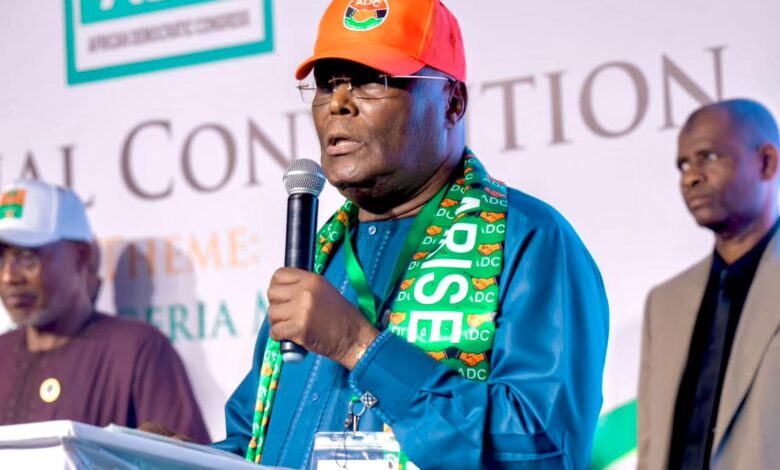
After the Court of Appeal overturned a Federal High Court ruling that attempted to bar the African Democratic Congress, ADC, and other political parties from Nigeria’s democratic space, former vice president Atiku Abubakar declared on Tuesday that the country’s 2027 general election must be decided at the polls, not in court.
The decision frees the ADC’s leadership from legal challenges, enabling the party to concentrate on the 2027 general election rather than engaging in legal disputes.
Atiku praised the justices of the Court of Appeal for their bravery, loyalty to the Constitution, and unwavering dedication to justice in a statement released by his media office in Abuja. He claimed that the ruling had bolstered constitutional democracy and public trust in the judiciary.
He stated, “As the country moves closer to the general elections in 2027, political contests must be decided by the votes of Nigerians—not by contrived lawsuits seeking to achieve in the courtroom what cannot be won at the ballot box.”
The statement claims that the appellate court’s decision, along with a previous ruling by Justice Liman of the Federal High Court, Abuja Division, upholding the National Executive Committee of the ADC led by Senator David Mark, has essentially ended all legal action contesting the party’s leadership prior to the 2027 general election.
The development, according to the statement, solidifies the ADC’s legal standing to take part in the elections.
The statement also stated that the Court of Appeal ruled that Justice Lifu’s June 15 ruling was invalid due to its disregard for an existing appellate court order. It further stated that the respondents’ claims were speculative and legally untenable, and that they lacked the locus standi to initiate the action.
Additionally, it stated that the appellate court held that the suit was premature because the Osun and Ekiti election cycles were still in progress at the time the action was filed and clarified that Section 225A of the Constitution should be interpreted disjunctively rather than conjunctively.
Atiku claims that the appellate court also criticized the trial court for ignoring the Independent National Electoral Commission’s (INEC) uncontested affidavit evidence, which attested to the ADC’s and the other impacted political parties’ compliance with all legal and constitutional requirements.
He continued, “The lower court had no legal basis to fabricate additional conditions in order to arrive at what the Court of Appeal correctly described as a perverse decision after accepting INEC’s evidence.”

According to Atiku, the ruling was a victory for constitutional democracy, the rule of law, and all Nigerians who support free political competition, and it went well beyond the success of a single political party.
He said, “The strength of a democracy lies in allowing the people to freely determine their leaders through the ballot, not in excluding political opponents.”
Additionally, he warned that attempts to use the judiciary and other state institutions as weapons for political engineering could undermine the nation’s constitutional order and erode public trust in democratic institutions.
He cautioned, “The judiciary must never be transformed into a battlefield for eliminating political competitors or shrinking the democratic space.”
Nevertheless, Atiku thanked the Justices of the Court of Appeal for what he called a brave, unbiased, and constitutionally sound ruling, stating that it had reinforced the rule of law’s superiority over political expediency and increased public trust in the administration of justice.