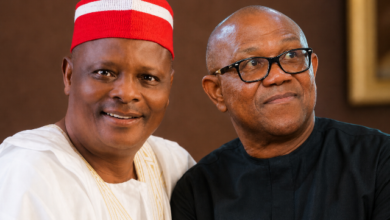

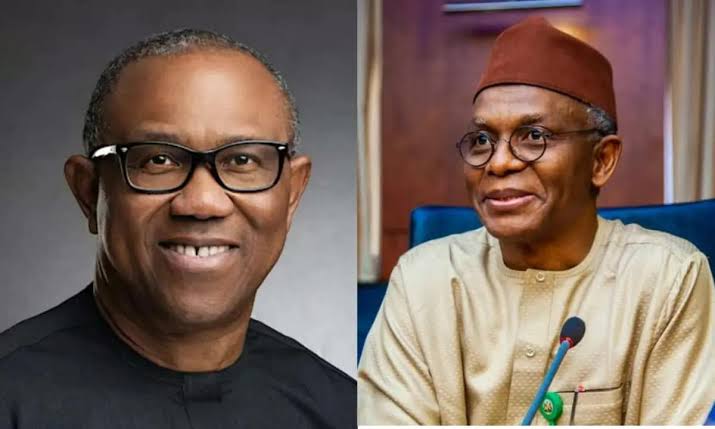
Mohammed Bello El-Rufai, son of former Kaduna State Governor Nasir El-Rufai, has expressed appreciation to former Anambra State Governor Peter Obi for repeatedly checking on his father during his prolonged detention.
Bello, who represents Kaduna North Federal Constituency in the House of Representatives, said Obi had consistently contacted him to ask about his father’s condition while the former governor remained in the custody of the Independent Corrupt Practices and Other Related Offences Commission.
Speaking during an interview that circulated online, Bello said several prominent Nigerian politicians had reached out to him over the situation involving his father.
He mentioned former Vice President Atiku Abubakar, Peter Obi, former Rivers State Governor Rotimi Amaechi and former Kano State Governor Rabiu Kwankwaso among those who had contacted him.
However, Bello singled out Obi for particular appreciation, noting that the former Anambra governor had repeatedly made personal calls to check on Nasir El-Rufai.
The gesture appeared particularly significant to Bello because he acknowledged that he had previously been critical of Obi.
He said the experience had taught him a personal lesson about the importance of human relationships and compassion, particularly when political disagreements exist between individuals.
Bello’s comments have attracted attention because of the increasingly competitive political environment ahead of Nigeria’s 2027 general elections.
Obi is currently a major opposition political figure and is expected to be active in the 2027 presidential contest, while Nasir El-Rufai has also moved into the opposition political space after leaving the APC.
The interaction between members of the two political camps has therefore generated discussion about whether personal relationships can survive disagreements over politics and ideology.
Bello’s remarks suggest that, despite his previous criticism of Obi, the former governor’s concern for his detained father changed the way he viewed the opposition politician.
For Bello, the repeated calls were not necessarily about political alliances but about checking on the wellbeing of a family member facing a difficult period.
The former Kaduna governor has been in the custody of the ICPC since February 18, 2026, as part of an ongoing investigation.
The anti-corruption agency confirmed that El-Rufai was in its custody in connection with an investigation, while the former governor and his legal representatives have challenged aspects of the actions taken against him.
His detention has subsequently become a political and legal issue, attracting comments from opposition figures and supporters who have raised questions about the length and circumstances of his continued detention.
Peter Obi has previously criticised the prolonged detention and described it as political persecution, while calling for due process and the rule of law.
That characterisation is Obi’s political assessment and has not been established as a finding by a court.
El-Rufai has also faced a separate legal proceeding involving the Department of State Services.
The DSS case relates to allegations concerning the interception of a telephone conversation involving National Security Adviser Nuhu Ribadu.
El-Rufai has denied wrongdoing and pleaded not guilty in the matter.
His legal team has also challenged the evidence presented by the prosecution and sought to have the case dismissed at the appropriate stage of the proceedings.
The former governor’s legal battles have therefore continued alongside his detention and wider political activities.
Despite the pressure surrounding his father’s legal situation, Bello said the former governor had been using his time in custody for personal reflection and reading.
According to his son, El-Rufai had spent part of the period reading books and studying the Quran.
He also suggested that the experience had given his father an opportunity to reflect on his previous work and consider how he might approach certain issues differently.
The comments provide a glimpse into how the family has been coping with the former governor’s continued detention.
Bello’s appreciation for politicians who contacted him also highlights the personal dimension of political disputes.
In Nigerian politics, individuals who frequently oppose one another publicly can still maintain personal relationships or demonstrate concern when serious circumstances affect their families.
The former Kaduna governor has had a long and sometimes controversial political career.
He served as Kaduna State governor from 2015 to 2023 and was previously a minister in the Federal Capital Territory.
Since leaving office, he has remained an influential figure in national political discussions.
His political activities have become particularly relevant ahead of 2027, especially after his movement away from the ruling APC and his involvement with opposition figures.
Peter Obi, meanwhile, has continued to build his political platform after finishing third in the 2023 presidential election.
His support base from the 2023 election remains an important part of his political identity, while his current opposition activities have placed him among the figures seeking to shape the political landscape ahead of 2027.
The contact between Obi and Bello El-Rufai therefore comes at a politically sensitive time.
However, Bello’s appreciation does not necessarily indicate a political alliance between the El-Rufai family and Obi.
His remarks were focused primarily on the personal support he said Obi provided during his father’s detention.
The same applies to the other politicians he mentioned.
Reaching out to a family member during a difficult period does not automatically translate into political cooperation or agreement on policy.
The development nevertheless offers an example of how political relationships can become more complicated than public disagreements suggest.
Bello’s admission that he had previously criticised Obi, followed by his public appreciation of Obi’s concern for his father, illustrates how personal experiences can alter perceptions of political opponents.
It also reinforces the distinction between political competition and personal conduct.
As Nigeria approaches the 2027 elections, political parties and their supporters are expected to engage in increasingly intense debates over governance, leadership, economic policies and the direction of the country.
The case involving Nasir El-Rufai is also likely to remain part of wider discussions about anti-corruption investigations, detention, due process and the treatment of opposition politicians.
For the El-Rufai family, however, the immediate concern remains the former governor’s legal situation and wellbeing.
Bello’s public appreciation of Obi has now added a more personal dimension to the continuing story.
It has also drawn attention to the support the family says it has received from different political figures across party lines.
Whether those relationships will have any political significance ahead of 2027 remains separate from the personal gesture Bello acknowledged.
For now, his message is centred on gratitude to those who took the time to ask about his father’s condition, with particular recognition for Peter Obi, whose repeated calls he said made a lasting impression on him.
The episode has consequently become a reminder that political disagreements do not always eliminate personal empathy, even among individuals operating on different sides of Nigeria’s increasingly competitive political landscape.